S6E5 Driver's High: Driver 피처의 잔여 신호 — OOF Ladder 검증
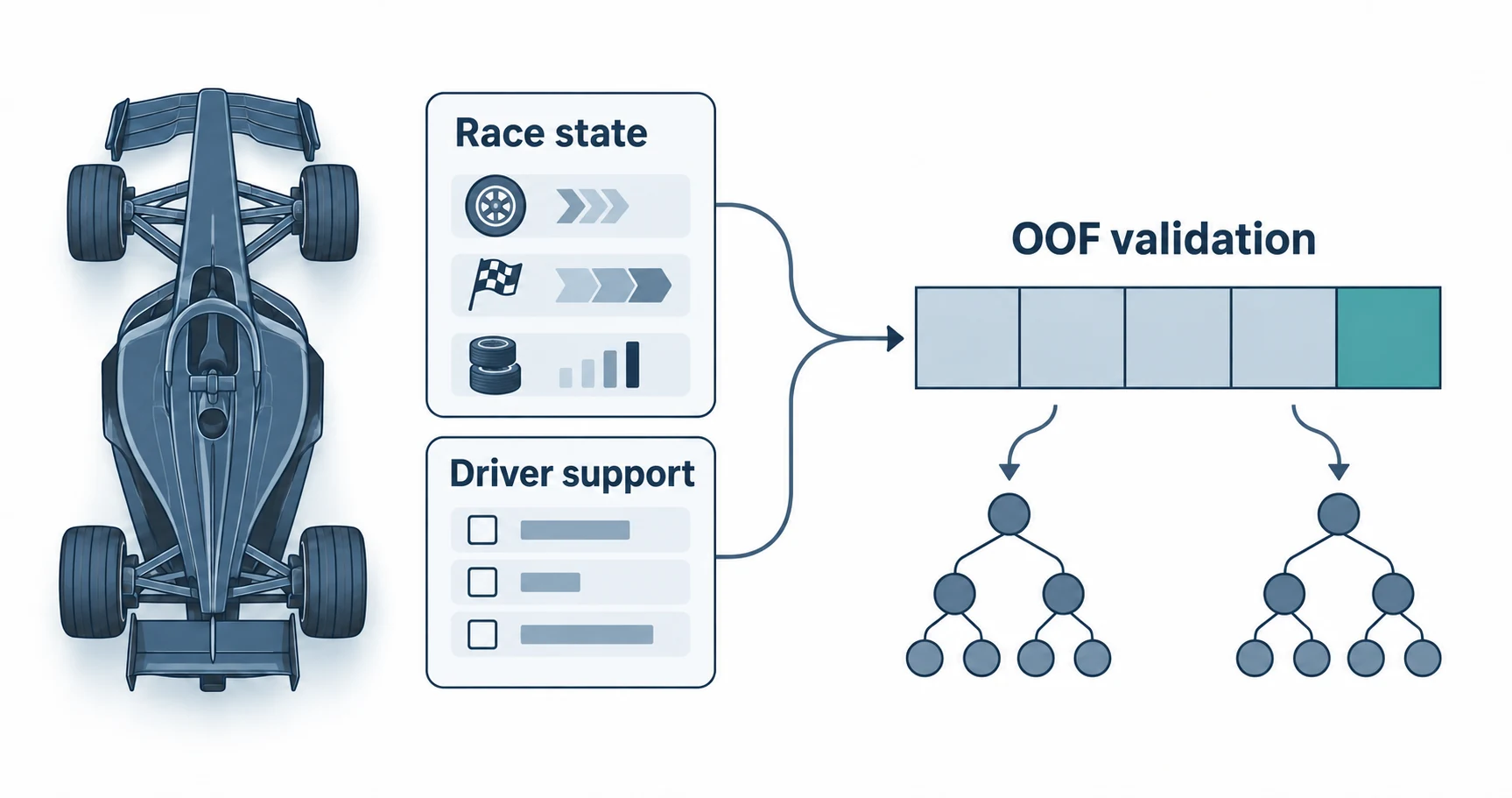
S6E5 Driver’s High: Driver 피처의 잔여 신호 — OOF Ladder 검증
Kaggle 노트북 링크:
S6E5 Driver’s High: Driver Feature Engineering
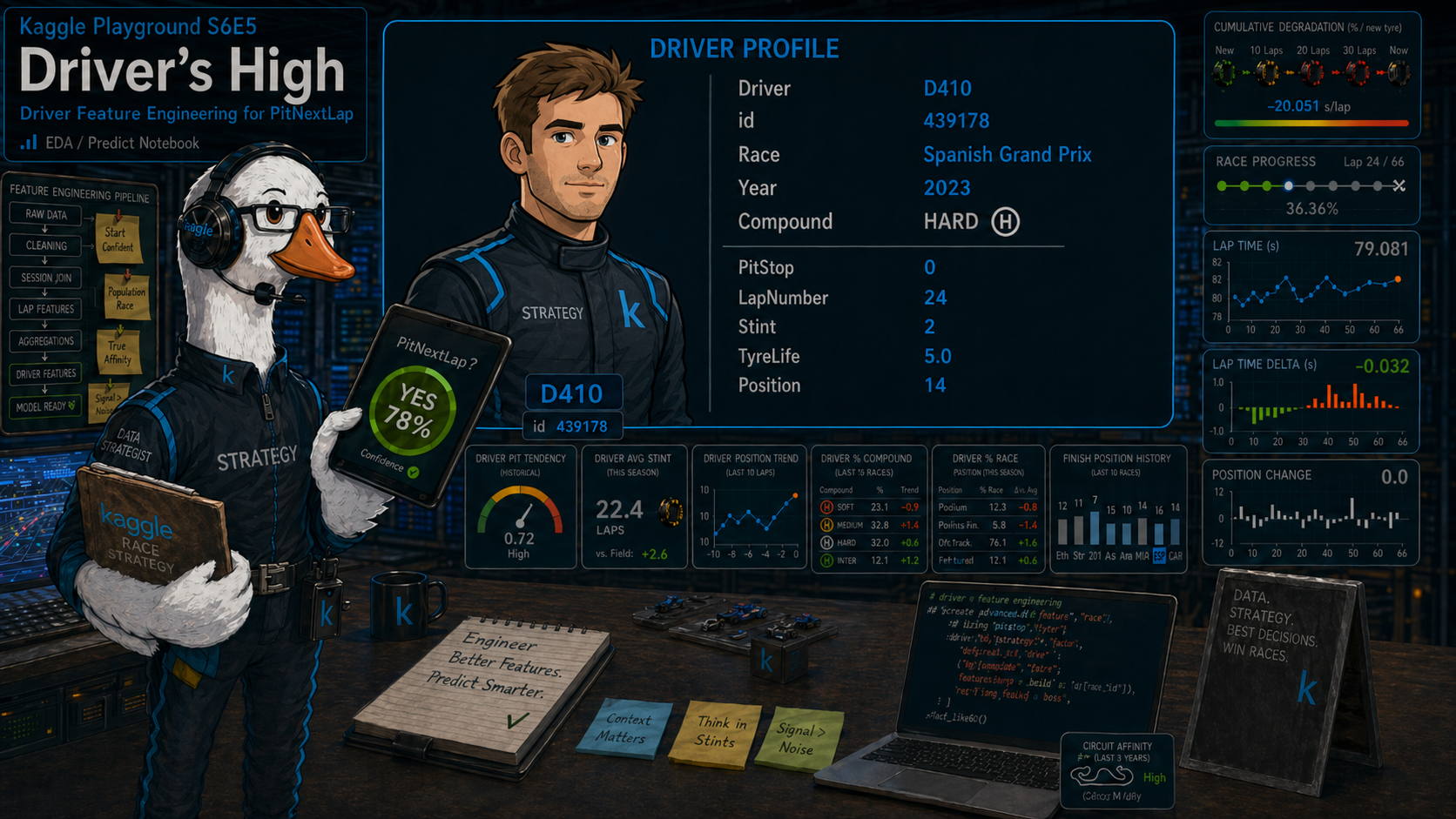
이 노트북의 질문은 좁고 명확합니다.
race state, tyre state, compound, stint 정보를 이미 넣은 뒤에도
Driver에는 따로 측정 가능한 신호가 남아 있는가?
Pit stop 예측에서 Driver는 매력적인 변수입니다. 실제 전략을 수행하는 주체처럼 보이기 때문입니다. 하지만 통계적으로는 위험한 변수이기도 합니다. Driver는 고카디널리티 categorical feature이고, 잘못 쓰면 재사용 가능한 신호가 아니라 category memorization을 학습할 수 있습니다.
따라서 Driver feature engineering은 하나의 큰 feature를 추가하는 일이 아니라, 위험도가 다른 표현을 차례대로 검증하는 과정입니다.
\[\Delta_{\text{AUC}}(B) = \operatorname{AUC}\!\left(\hat p_{\text{base}+B}^{\text{oof}}, y\right) - \operatorname{AUC}\!\left(\hat p_{\text{counterfactual}}^{\text{oof}}, y\right)\]여기서 (B)는 후보 feature block입니다. 중요한 건 단순히 AUC가 오르는지 보는 게 아니라, 같은 OOF protocol 아래에서 올바른 counterfactual보다 좋아지는지입니다.
1. 모델링 질문
Target은 다음 lap에 pit stop을 하는지 여부입니다.
\[y_i = \begin{cases} 1, & \text{pit next lap} \\ 0, & \text{otherwise} \end{cases}\]모델은 다음 확률을 예측합니다.
\[\hat p_i = P(y_i = 1 \mid x_i)\]평가 지표는 ROC-AUC입니다. AUC는 양성 row가 음성 row보다 더 높은 점수를 받을 확률로 해석할 수 있습니다.
\[\operatorname{AUC} = P(\hat p^+ > \hat p^-) + \frac{1}{2}P(\hat p^+ = \hat p^-)\]따라서 Driver의 가치는 어떤 row의 확률을 조금 바꾸는 데 있지 않습니다. 양성 row와 음성 row의 상대적 순위를 더 잘 만들 수 있는지가 핵심입니다.
| 층 | 역할 | 통계적 위험 |
|---|---|---|
| Race-state foundation | lap, progress, stint, tyre age, degradation | race state가 약하면 underfit이 생깁니다. |
| Compound and tyre pressure | compound별 기대 수명 대비 tyre age | compound 효과를 raw ID처럼만 쓰면 scale이 어긋납니다. |
| Driver representation | string structure, frequency, target prior, interaction | 고카디널리티 누수 또는 memorization |
| OOF protocol | 같은 split, 한 번에 하나의 block만 변경 | validation row가 자기 target을 encode하면 false lift가 생깁니다. |
| Stack / residual layer | Driver 신호를 더 강한 artifact와 비교 | 실제 gain이 model family나 original data에서 왔는데 Driver에 과대 부여할 수 있습니다. |
핵심 설계는 Driver를 하나의 feature로 통째로 넣지 않는 것입니다. 대신 안전한 표현부터 위험한 표현까지 ladder 형태로 분리합니다.
2. Driver Inventory
먼저 Driver가 현실의 작은 category인지, 아니면 synthetic high-cardinality category인지 확인합니다.
| Dataset | Rows | Unique Drivers | D... Code Rate | 3-Letter Rate |
|---|---|---|---|---|
| Train | 439,140 | 887 | 59.58% | 40.42% |
| Test | 188,165 | 801 | 59.34% | 40.66% |
| Original | 101,371 | 31 | 0.00% | 100.00% |
Train/test에는 D### 형태의 synthetic ID가 많고, original data는 3-letter driver code로 구성되어 있습니다. 이 차이는 중요합니다. 같은 Driver 컬럼이라도 두 데이터 소스의 의미가 완전히 같지 않기 때문입니다.
Driver signal은 다음처럼 나눠 볼 수 있습니다.
| Driver Signal | 의미 | Leakage Risk |
|---|---|---|
| String structure | D###인지 3-letter code인지, numeric ID bin | 낮음 |
| Original vocabulary flag | original data에 등장한 Driver인지 | 낮음에서 중간 |
| Frequency/support | Driver/Race context 뒤에 있는 row 수 | 낮음 |
| Target encoding | category별 smoothed pit-stop prior | fold-safe가 아니면 높음 |
| Interaction target encoding | Driver-Compound, Race-Stint, Compound-Stint prior | variance가 더 큼 |
Support distribution도 함께 봐야 합니다.
| Threshold | Drivers | Covered Rows | Covered Row Rate |
|---|---|---|---|
>= 10 rows | 666 | 438,432 | 99.84% |
>= 50 rows | 535 | 435,485 | 99.17% |
>= 100 rows | 485 | 431,979 | 98.37% |
>= 250 rows | 411 | 419,501 | 95.53% |
>= 500 rows | 337 | 392,580 | 89.40% |
대부분의 row는 충분한 support를 가진 driver에 속합니다. 그래서 frequency feature는 통계적으로 의미가 있습니다. 다만 long tail도 충분히 크기 때문에, raw one-hot identity는 여전히 overfit하기 쉽습니다.
코드: 데이터 로딩과 Driver inventory
1
2
3
4
5
6
7
8
9
10
11
12
13
14
15
16
17
18
19
20
21
22
23
24
25
26
27
28
29
30
31
32
33
train = pd.read_csv(train_path)
test = pd.read_csv(test_path)
submission_template = pd.read_csv(submission_path)
original = pd.read_csv(original_path) if original_path is not None else None

TARGET = resolve_target_column(train, TARGET_CANDIDATES, "train")
SUBMISSION_TARGET = resolve_target_column(submission_template, TARGET_CANDIDATES, "sample_submission")

ID_COL = "id"
base_features = [col for col in test.columns if col != ID_COL]
raw_numeric_cols = [col for col in base_features if pd.api.types.is_numeric_dtype(train[col])]
raw_categorical_cols = [col for col in base_features if col not in raw_numeric_cols]
original_driver_set = set(original["Driver"].astype(str)) if original is not None and "Driver" in original else set()

driver_inventory = pd.DataFrame({
    "Dataset": ["Train", "Test", "Original" if original is not None else "Original missing"],
    "Rows": [len(train), len(test), len(original) if original is not None else 0],
    "Unique_Drivers": [
        train["Driver"].nunique(),
        test["Driver"].nunique(),
        original["Driver"].nunique() if original is not None else 0,
    ],
    "D_Code_Rate": [
        train["Driver"].astype(str).str.match(r"^D\d+$").mean(),
        test["Driver"].astype(str).str.match(r"^D\d+$").mean(),
        original["Driver"].astype(str).str.match(r"^D\d+$").mean() if original is not None else np.nan,
    ],
    "Three_Letter_Rate": [
        train["Driver"].astype(str).str.match(r"^[A-Z]{3}$").mean(),
        test["Driver"].astype(str).str.match(r"^[A-Z]{3}$").mean(),
        original["Driver"].astype(str).str.match(r"^[A-Z]{3}$").mean() if original is not None else np.nan,
    ],
})
3. Race-State Foundation
Driver를 측정하기 전에 non-Driver baseline이 충분히 강해야 합니다. 그렇지 않으면 모델은 race state가 설명해야 할 변동을 Driver에게 잘못 부여할 수 있습니다.
먼저 race length를 추정합니다.
\[\widehat L_i = \frac{\text{LapNumber}_i}{\text{RaceProgress}_i}\]남은 race state와 tyre life scale은 다음처럼 만듭니다.
\[R_i = 1 - \text{RaceProgress}_i, \qquad \text{NormalizedTyreLife}_i = \frac{\text{TyreLife}_i}{\widehat L_i}\]Compound별 tyre pressure는 compound 기대 수명 대비 tyre age로 표현합니다.
\[u_i = \frac{\text{TyreLife}_i}{E[\text{Life}\mid \text{Compound}_i]}\]Pit window indicator는 다음과 같습니다.
\[\mathbb{1}\!\left(u_i \ge w_{\text{Compound}_i}\right)\]이렇게 하면 모든 TyreLife 값을 같은 scale로 보지 않고, compound별 기대 수명에 맞춰 비교할 수 있습니다.
| Feature Block | 주요 변수 | 해석 |
|---|---|---|
| Race/tyre algebra | estimated race laps, laps remaining, normalized tyre life | race phase와 tyre age scale |
| Compound structure | hardness, dry/wet-like flags, tyre-life × hardness | compound별 wear pressure |
| Public domain features | pit window, degradation per lap, stop urgency | F1 strategy pressure |
| Nonlinear interactions | tyre life × progress, tyre life × stint, degradation × age | threshold-like pit behavior |
코드: race-state와 compound feature block
1
2
3
4
5
6
7
8
9
10
11
12
13
14
15
16
17
18
19
20
21
22
23
24
25
26
27
28
29
30
31
32
33
34
35
36
37
38
39
40
41
42
43
44
45
46
47
48
49
50
COMPOUND_EXPECTED_LIFE = {
    "SOFT": 25.0,
    "MEDIUM": 35.0,
    "HARD": 45.0,
    "INTERMEDIATE": 30.0,
    "WET": 40.0,
}

COMPOUND_WINDOW_START = {
    "SOFT": 0.64,
    "MEDIUM": 0.68,
    "HARD": 0.72,
    "INTERMEDIATE": 0.62,
    "WET": 0.60,
}

def add_race_tyre_algebra(df):
    out = df.copy()
    estimated_laps = _safe_divide(
        out["LapNumber"].astype(float),
        out["RaceProgress"].astype(float),
    ).replace([np.inf, -np.inf], np.nan)

    out["EstimatedRaceLaps"] = estimated_laps.clip(lower=1, upper=120)
    out["LapsRemainingEstimate"] = (out["EstimatedRaceLaps"] - out["LapNumber"]).clip(lower=-10, upper=120)
    out["RemainingRaceProgress"] = (1.0 - out["RaceProgress"].astype(float)).clip(-0.1, 1.1)
    out["TyreLifeToLapNumber"] = _safe_divide(out["TyreLife"].astype(float), out["LapNumber"].astype(float))
    out["TyreLifeToRaceProgress"] = _safe_divide(out["TyreLife"].astype(float), out["RaceProgress"].astype(float))
    out["NormalizedTyreLifeEstimate"] = _safe_divide(out["TyreLife"].astype(float), out["EstimatedRaceLaps"].astype(float))
    return out

def add_public_domain_features(df):
    out = df.copy()
    expected_life = out["Compound"].astype(str).map(COMPOUND_EXPECTED_LIFE).fillna(35.0)
    window_start = out["Compound"].astype(str).map(COMPOUND_WINDOW_START).fillna(0.68)

    tyre_life = out["TyreLife"].astype(float)
    race_progress = out["RaceProgress"].astype(float).clip(0, 1.05)
    lap_delta = out["LapTime_Delta"].astype(float)
    cum_deg = out["Cumulative_Degradation"].astype(float)

    out["TyreLifePct"] = _safe_divide(tyre_life, expected_life).clip(0, 3)
    out["PitWindowStartPct"] = window_start
    out["InCompoundPitWindow"] = (out["TyreLifePct"] >= window_start).astype(int)
    out["WindowOvershootPct"] = (out["TyreLifePct"] - window_start).clip(lower=0, upper=2)
    out["DegPerLap"] = _safe_divide(cum_deg, tyre_life + 1.0)
    out["PositiveLapTimeDelta"] = lap_delta.clip(lower=0)
    out["AgeXDelta"] = tyre_life * out["PositiveLapTimeDelta"]
    out["StopUrgency"] = out["TyreLifePct"] * race_progress * (1.0 + 0.20 * out["Stint"].astype(float).clip(1, 4))
    return out
4. Driver Representation
Driver ladder는 안전한 정보에서 시작해 점점 위험한 encoding으로 넘어갑니다.
4.1 String Structure
가장 안전한 표현은 raw one-hot identity가 아니라 문자열 구조입니다.
\[\text{Driver} \mapsto \left[ \mathbb{1}_{D\text{-code}}, \mathbb{1}_{3\text{-letter}}, \text{DriverNum}, \text{DriverNumBin}, \mathbb{1}_{\text{missing num}} \right]\]이 표현은 driver마다 dummy variable을 만들지 않으면서 synthetic ID와 original vocabulary의 구조 차이를 잡습니다.
4.2 Frequency Encoding
Category key (c)에 대해 frequency encoding은 다음 값을 추가합니다.
\[n(c) = \sum_i \mathbb{1}(x_i = c), \qquad f(c) = \log(1+n(c))\]Rare driver flag도 둡니다.
\[\mathbb{1}\{n(\text{Driver}) < 50\}\]이 feature는 “많이 등장한 driver가 더 좋다”는 뜻이 아닙니다. 해당 category estimate가 얼마나 많은 support 위에 있는지를 모델에게 알려주는 역할입니다.
4.3 Context Normalization
Race-relative z-score는 row를 자기 주변 context와 비교합니다.
\[z_{i,g,v} = \frac{x_{i,v} - \mu_{g(i),v}}{\sigma_{g(i),v} + \epsilon}\]여기서 (g(i))는 Race, Race_Compound, Race_Lap, Compound 등이 될 수 있습니다. Pit timing은 절대값만으로 결정되지 않습니다. 어떤 race/lap에서는 오래된 tyre가 평범할 수 있고, 다른 context에서는 곧바로 pit pressure가 될 수 있습니다.
4.4 Target Encoding
Category (c)에 대한 smoothed target prior는 다음과 같습니다.
\[\operatorname{TE}(c) = \frac{\sum_{i:g_i=c} w_i y_i + \alpha \bar y} {\sum_{i:g_i=c} w_i + \alpha}\]Smoothing parameter (\alpha)는 global mean으로 shrink하는 힘입니다. Driver_Compound처럼 support가 얇은 interaction에서는 큰 (\alpha)가 필요합니다.
코드: Driver structure, count map, target encoding
1
2
3
4
5
6
7
8
9
10
11
12
13
14
15
16
17
18
19
20
21
22
23
24
25
26
27
28
29
30
31
32
33
34
35
36
37
38
39
40
41
42
43
44
45
46
def add_driver_structure(df):
    out = df.copy()
    driver = out["Driver"].astype(str)
    extracted = driver.str.extract(r"^D(\d+)$", expand=False)
    out["Driver_is_D_code"] = driver.str.match(r"^D\d+$").astype(int)
    out["Driver_is_3letter"] = driver.str.match(r"^[A-Z]{3}$").astype(int)
    out["Driver_num"] = pd.to_numeric(extracted, errors="coerce").fillna(-1)
    out["Driver_num_missing"] = (out["Driver_num"] < 0).astype(int)
    bins = [-2, -0.5, 99, 199, 399, 699, 9999]
    out["Driver_num_bin"] = pd.cut(out["Driver_num"], bins=bins, labels=False, include_lowest=True).astype(float)
    return out

def fit_count_maps(fit_df, columns, weight=None):
    w = np.ones(len(fit_df), dtype=float) if weight is None else np.asarray(weight, dtype=float)
    maps = {}
    for col in columns:
        tmp = pd.DataFrame({col: fit_df[col].astype(str), "__w": w})
        maps[col] = tmp.groupby(col, observed=True)["__w"].sum()
    return maps

def apply_count_maps(df, count_maps):
    out = df.copy()
    for col, counts in count_maps.items():
        mapped = out[col].astype(str).map(counts).fillna(0).astype(float)
        out[f"{col}_count"] = mapped
        out[f"{col}_freq_log1p"] = np.log1p(mapped)
        if col == "Driver":
            out["Driver_is_rare_50"] = (mapped < 50).astype(int)
    return out

def fit_target_maps(fit_df, columns, target, weight=None, alpha=80):
    y = fit_df[target].astype(float).to_numpy()
    w = np.ones(len(fit_df), dtype=float) if weight is None else np.asarray(weight, dtype=float)
    prior = np.average(y, weights=w)
    maps = {}
    tmp = fit_df.copy()
    tmp["__y"] = y
    tmp["__w"] = w
    tmp["__yw"] = y * w
    for col in columns:
        grouped = tmp.groupby(col, observed=True).agg(
            weight_sum=("__w", "sum"),
            target_sum=("__yw", "sum"),
        )
        maps[col] = ((grouped["target_sum"] + alpha * prior) / (grouped["weight_sum"] + alpha)).to_dict()
    return maps, prior
5. Fold-Safe Validation
가장 중요한 구현 조건은 모든 fitted transformation을 fold 안에서만 학습하는 것입니다.
Fold (k)에 대해:
\[\mathcal{D}_{-k} = \text{training rows outside fold } k, \qquad \mathcal{D}_{k} = \text{validation rows inside fold } k\]Fitted encoder (T_k)는 반드시 다음 조건을 만족해야 합니다.
\[T_k = \operatorname{fit}(\mathcal{D}_{-k}), \qquad X_k^{\text{valid}} = T_k(\mathcal{D}_k)\]Target encoding은 training side에도 inner OOF encoding이 필요합니다. 그렇지 않으면 한 row가 자기 자신의 target을 encode할 수 있습니다.
\[\hat z_i = \operatorname{TE}_{-h(i)}(x_i)\]여기서 (h(i))는 row (i)가 속한 inner fold입니다.
코드: fold-safe feature fitting과 OOF runner
1
2
3
4
5
6
7
8
9
10
11
12
13
14
15
16
17
18
19
20
21
22
23
24
25
26
27
28
29
30
31
32
33
34
def fit_fold_features(fit_df, valid_df, test_df, blocks, target, fit_weight=None):
    fit_x = prepare_static_features(fit_df, blocks)
    valid_x = prepare_static_features(valid_df, blocks)
    test_x = prepare_static_features(test_df, blocks)

    if "frequency_encoding" in blocks:
        count_maps = fit_count_maps(fit_x, FREQUENCY_COLUMNS, weight=fit_weight)
        fit_x = apply_count_maps(fit_x, count_maps)
        valid_x = apply_count_maps(valid_x, count_maps)
        test_x = apply_count_maps(test_x, count_maps)

    if "context_normalization" in blocks:
        value_cols = sorted({value for values in CONTEXT_GROUP_SPECS.values() for value in values})
        global_stats = fit_global_stats(fit_x, value_cols, weight=fit_weight)
        group_stats = fit_group_stats(fit_x, CONTEXT_GROUP_SPECS, weight=fit_weight)
        fit_x = apply_group_stats(fit_x, group_stats, global_stats)
        valid_x = apply_group_stats(valid_x, group_stats, global_stats)
        test_x = apply_group_stats(test_x, group_stats, global_stats)

    if "oof_target_encoding" in blocks:
        fit_x = add_inner_oof_target_encoding(
            fit_x,
            target=target,
            columns=TARGET_ENCODING_COLUMNS,
            sample_weight=fit_weight,
            alpha=80,
            n_splits=INNER_TE_SPLITS,
            suffix="te",
        )
        maps, prior = fit_target_maps(fit_x, TARGET_ENCODING_COLUMNS, target, fit_weight, alpha=80)
        valid_x = apply_target_maps(valid_x, maps, prior, suffix="te")
        test_x = apply_target_maps(test_x, maps, prior, suffix="te")

    return fit_x, valid_x, test_x
6. Driver Ladder Results
Driver ladder는 세 갈래로 나뉩니다.
| Branch | 질문 | Counterfactual |
|---|---|---|
| Raw identity ladder | Driver one-hot이 직접 도움이 되는가? | Driver 없는 race-state foundation |
| Compressed ladder | raw OHE 없이도 Driver 신호가 살아남는가? | 같은 foundation에 Driver 표현을 하나씩 추가 |
| Interaction branch | Driver/compound/stint prior가 안정적인가? | B04 target-encoding parent |
6.1 Raw Driver OHE
| Experiment | Added Block | OOF AUC | Delta vs No Driver |
|---|---|---|---|
A00_no_driver | Race-state foundation without raw Driver ID | 0.946243 | 0.000000 |
A01_driver_ohe | Add raw Driver one-hot identity | 0.945964 | -0.000279 |
Raw Driver identity는 이 saved CV run에서 개선을 만들지 못했습니다. 이 음수 결과는 중요합니다. 고카디널리티 ID를 그대로 믿으면 variance나 memorization을 키울 수 있기 때문입니다.
6.2 Compressed Driver Signal
| Experiment | Added Block | OOF AUC | Delta vs No Driver | CV Read |
|---|---|---|---|---|
B00_no_driver | Race-state foundation | 0.946243 | 0.000000 | baseline |
B01_driver_string | Driver string structure | 0.946691 | +0.000448 | improves |
B02_original_vocab | original-driver vocabulary flag | 0.946586 | +0.000343 | below previous |
B03_driver_frequency | Driver/Race frequency features | 0.946818 | +0.000575 | best compressed step |
B04_driver_te | inner-OOF Driver/Race target encoding | 0.946670 | +0.000427 | below previous |
가장 좋은 saved Driver representation은 다음과 같습니다.
\[\texttt{B03\_driver\_frequency}\]개선폭은 작지만 방향은 안정적입니다.
\[\Delta_{\text{AUC}} = 0.946818 - 0.946243 = 0.000575\]Paired bootstrap에서도 같은 방향이 확인됩니다.
| Comparison | Mean Delta | P05 | Median | P95 | Probability Positive |
|---|---|---|---|---|---|
B03_driver_frequency - B00 | 0.000573 | 0.000384 | 0.000572 | 0.000764 | 1.000 |
6.3 Interaction Target Encoding
Interaction TE는 B04_driver_te parent를 넘지 못했습니다.
| Experiment | Parent | Delta vs Parent | Decision |
|---|---|---|---|
B05_driver_compound_te | B04_driver_te | -0.000261 | reject |
B06_race_compound_te | B04_driver_te | -0.000076 | reject |
B07_race_stint_te | B04_driver_te | -0.000143 | reject |
B08_compound_stint_te | B04_driver_te | -0.000125 | reject |
Sparse interaction에서 흔히 나오는 실패입니다. 조건부 prior 자체는 그럴듯하지만, support가 얇아지면서 variance penalty가 더 커집니다.
7. Score-Oriented Candidate Stack
Driver ladder 이후에는 public-stack style preprocessing이 현재 Driver-frequency selection을 넘는지 확인합니다.
| Candidate | Feature Count | OOF AUC | Delta vs Current Best |
|---|---|---|---|
S05_stack_core_preprocessing | 35 | 0.944899 | -0.0019 |
S06_stack_domain_preprocessing | 111 | 0.946050 | -0.0008 |
Domain matrix는 core matrix보다 낫지만, 이 local LGBM run에서는 B03_driver_frequency를 넘지 못했습니다. Sequence/group feature가 나쁘다는 뜻은 아닙니다. 이 feature들은 lightweight ladder보다 XGB/Cat/LGBM heavy stack과 더 잘 맞는 신호일 수 있습니다.
Score gap을 보면 Driver의 위치가 더 명확해집니다.
| Model or Stack | Reference OOF AUC | Gap vs B03_driver_frequency | 해석 |
|---|---|---|---|
B03_driver_frequency | 0.946818 | 0.000000 | current local best |
| Domain LGBM public reference | 0.948120 | +0.001302 | small improvement |
| RealMLP public reference | 0.949510 | +0.002692 | small improvement |
| XGB baseline + original | 0.958160 | +0.011342 | leaderboard-scale gap |
| XGB Optuna + original | 0.959940 | +0.013122 | leaderboard-scale gap |
| XGB + CatBoost ensemble | 0.960760 | +0.013942 | leaderboard-scale gap |
따라서 Driver는 primary axis라기보다 auxiliary signal에 가깝습니다. 더 큰 점수 이동은 model family, original data usage, ensemble structure에서 나옵니다.
8. Driver As A Residual Correction
두 번째 가설은 조금 더 섬세합니다.
Driver는 main feature로는 약해도, post-model calibration bias로는 쓸 수 있을지 모른다.
Residual layer는 logit space에서 작동합니다. Base prediction (\hat p_i)에 대해:
\[\operatorname{logit}(\hat p_i) = \log \frac{\hat p_i}{1-\hat p_i}\]Driver group (g)마다 smoothed observed rate와 smoothed predicted rate를 비교합니다.
\[\tilde y_g = \frac{\sum_{i:g_i=g} y_i + \alpha \bar y}{n_g+\alpha}, \qquad \tilde p_g = \frac{\sum_{i:g_i=g} \hat p_i + \alpha \bar p}{n_g+\alpha}\]Group residual은 다음과 같습니다.
\[\delta_g = \operatorname{logit}(\tilde y_g) - \operatorname{logit}(\tilde p_g)\]Corrected prediction은:
\[\hat p'_i = \sigma\!\left( \operatorname{logit}(\hat p_i) + \lambda \sum_{g \in G_i} w_g\delta_g \right)\](\lambda)는 OOF AUC로 선택합니다.
Saved local residual table은 다음과 같습니다.
| Experiment | Groups | Lambda | OOF AUC | Delta vs Base | Decision |
|---|---|---|---|---|---|
R00_base_selected_stack | none | 0.00 | 0.946818 | 0.000000 | base |
R01_driver_logit_bias | Driver | -0.25 | 0.946820 | +0.000002 | watchlist |
R02_driver_phase_logit_bias | Driver + Driver_Phase | -0.25 | 0.946820 | +0.000002 | watchlist |
R05_driver_strategy_logit_bias | Driver + phase + compound + stint | -0.10 | 0.946819 | +0.000001 | watchlist |
Promotion threshold는 다음과 같습니다.
\[\Delta_{\text{AUC}} \ge 0.0003\]Local residual gain은 이 기준보다 훨씬 작습니다. 따라서 final candidate가 아니라 watchlist signal로 남습니다.
9. Heavy-Stack Overlay
마지막 단계에서는 더 강한 OOF/test artifact 위에 Driver residual을 얹어 봅니다. 여기서 질문은 바뀝니다.
1
2
Driver signal이 lightweight ladder에서는 살아남았지만,
heavy stack 위에서도 독립적인 correction으로 남는가?
Stack search는 probability blend와 rank blend를 모두 봅니다.
\[\hat p^{\text{prob}}_i = \sum_{m=1}^{M} w_m \hat p_{im}, \qquad w_m \ge 0,\quad \sum_m w_m = 1\]Rank blend는 다음입니다.
\[\hat r_i = \sum_{m=1}^{M} w_m \operatorname{rank}_{01}(\hat p_{im})\]발견된 base model들의 OOF score는 다음과 같습니다.
| Model | OOF AUC |
|---|---|
realmlp_full_fullrows_5fold | 0.952177 |
lgb_domain_w07_full_fullrows_10fold | 0.950665 |
xgb_core_w1_full_fullrows_10fold | 0.950331 |
cat_core_w1_full_fullrows_10fold | 0.949682 |
xgb_public_te_w1_full_fullrows_10fold | 0.949381 |
선택된 heavy-stack artifact는 다음 수준에 도달했습니다.
\[\operatorname{AUC}_{\text{heavy stack}} \approx 0.953404\]Driver residual overlay는 약:
\[0.953409\]까지 올라갔지만, promotion threshold를 넘을 만큼 충분하지는 않았습니다. 그래서 final blend는 모든 weight를 heavy-stack artifact에 둡니다.
| Model | Blend Weight |
|---|---|
B03_driver_frequency | 0.000 |
H00_heavy_stack_artifact | 1.000 |
이 결과는 유용합니다. Driver frequency는 local signal로는 유효하지만, 더 강한 full-row stack prediction이 들어오면 Driver residual이 artifact base를 대체할 만큼 독립적인 개선을 만들지는 못한다는 뜻입니다.
10. Final Submission Logic
최종 파일은 표준 probability submission입니다. Row count, ID alignment, probability bounds, missing value를 확인합니다.
\[0 \le \hat p_i \le 1\]저장된 제출 요약은 다음과 같습니다.
| Rows | Mean Prediction | Min Prediction | Max Prediction | Filename |
|---|---|---|---|---|
| 188,165 | 0.1982 | 0.0001 | 0.9954 | submission.csv |
코드: final submission check
1
2
3
4
5
6
7
8
9
10
11
12
13
14
15
16
17
submission = submission_template.copy()
submission[SUBMISSION_TARGET] = np.clip(blend_test, 0, 1)

assert submission.shape[0] == test.shape[0]
assert submission[ID_COL].equals(test[ID_COL])
assert submission[SUBMISSION_TARGET].between(0, 1).all()
assert submission[SUBMISSION_TARGET].isna().sum() == 0

submission.to_csv(SUBMISSION_FILENAME, index=False)

submission_summary = pd.DataFrame({
    "Rows": [len(submission)],
    "Mean_Prediction": [submission[SUBMISSION_TARGET].mean()],
    "Min_Prediction": [submission[SUBMISSION_TARGET].min()],
    "Max_Prediction": [submission[SUBMISSION_TARGET].max()],
    "Filename": [SUBMISSION_FILENAME],
})
11. 결론
결론은 “Driver가 중요하다” 또는 “Driver가 중요하지 않다”처럼 단순하지 않습니다. 더 정확한 해석은 다음과 같습니다.
| Claim | Evidence | Decision |
|---|---|---|
| Raw Driver one-hot은 충분하지 않습니다 | A01 - A00 = -0.000279 AUC | reject in saved CV |
| Compressed Driver support는 유용합니다 | B03 - B00 = +0.000575 AUC | keep as local signal |
| Target encoding은 강한 guardrail이 필요합니다 | B04가 B03보다 낮음 | complexity만으로 promote하지 않음 |
| Interaction TE는 variance가 큽니다 | 모든 interaction이 parent보다 낮음 | reject interaction branches |
| Public-style stack feature는 더 강한 모델과 맞습니다 | local LGBM stack candidates가 B03보다 낮음 | heavier stack에서 유지 |
| Driver residual은 promote되지 않습니다 | gain이 몇 (10^{-6}) AUC 수준 | watchlist only |
| Heavy-stack artifact가 final blend를 지배합니다 | artifact stack weight 1.0 | final submission base |
11.1 통계적 의미
이 결과를 driver skill에 대한 causal claim으로 읽으면 안 됩니다. 특정 driver가 pit strategy를 본질적으로 더 잘한다는 걸 증명한 게 아닙니다.
더 좁은 결론은 다음과 같습니다.
Race-state, tyre-state, compound, stint, degradation feature가 이미 들어간 뒤에도, Driver-derived support와 frequency variable에는 작은 OOF ranking signal이 남아 있다.
관련 marginal effect는 다음과 같습니다.
\[\Delta_{\text{Driver frequency}} = \operatorname{AUC}(\text{race-state} + \text{Driver frequency}) - \operatorname{AUC}(\text{race-state only})\]Saved run에서는:
\[\Delta_{\text{Driver frequency}} = 0.946818 - 0.946243 = 0.000575\]따라서 조심스러운 통계적 해석은 다음과 같습니다.
Driver frequency는 controlled OOF protocol 아래에서 작지만 측정 가능한 marginal predictive utility를 갖는다.
이건 raw Driver identity가 유용하다는 말과 다릅니다. Raw one-hot Driver identity는 오히려 나쁜 방향으로 움직였습니다.
\[\Delta_{\text{raw Driver OHE}} = 0.945964 - 0.946243 = -0.000279\]이 음수 결과가 중요합니다. 고카디널리티 Driver ID는 불안정한 category effect를 외우거나 variance를 키울 수 있습니다. 반면 support count와 frequency log처럼 variance가 낮은 summary는 더 robust합니다.
즉 살아남은 Driver signal은 직접적인 identity effect라기보다, support-size / reliability proxy에 가깝습니다.
\[\text{Driver} \not\Rightarrow \text{skill claim} \qquad \text{Driver frequency} \Rightarrow \text{category support and generator-context signal}\]Residual correction 결과는 해석의 두 번째 부분을 줍니다. 더 강한 stack artifact를 base로 쓰면 Driver residual correction은 promotion threshold를 넘지 못합니다.
\[\operatorname{AUC}_{\text{corrected}} - \operatorname{AUC}_{\text{base}} < 0.0003\]이는 작은 Driver signal이 강한 stack 안에 이미 흡수되었거나, post-stack correction으로 독립적으로 살아남기에는 너무 약하다는 뜻입니다.
따라서 Driver는 primary modeling axis가 아니라 low-amplitude auxiliary feature로 보는 게 맞습니다.
전체 통계 구조는 다음과 같습니다.
\[\text{Driver ID} \rightarrow \text{Driver compression} \rightarrow \text{fold-safe Driver prior} \rightarrow \text{residual Driver correction} \rightarrow \text{heavy-stack comparison}\]중요한 건 counterfactual discipline입니다. Driver 아이디어는 매번 다음 질문에 답해야 합니다.
\[\operatorname{AUC}_{\text{candidate}} - \operatorname{AUC}_{\text{matching counterfactual}} > 0\]Residual overlay는 더 강한 기준을 통과해야 합니다.
\[\operatorname{AUC}_{\text{corrected}} - \operatorname{AUC}_{\text{base}} \ge 0.0003\]그래서 최종 해석은 보수적입니다.
Driver frequency는 작지만 측정 가능한 신호로 남습니다. 하지만 stronger stack artifact를 base로 둔 뒤에는 Driver residual correction이 아직 promote될 만큼 강하지 않습니다.