S6E5 Driver's High: Driver Feature Engineering
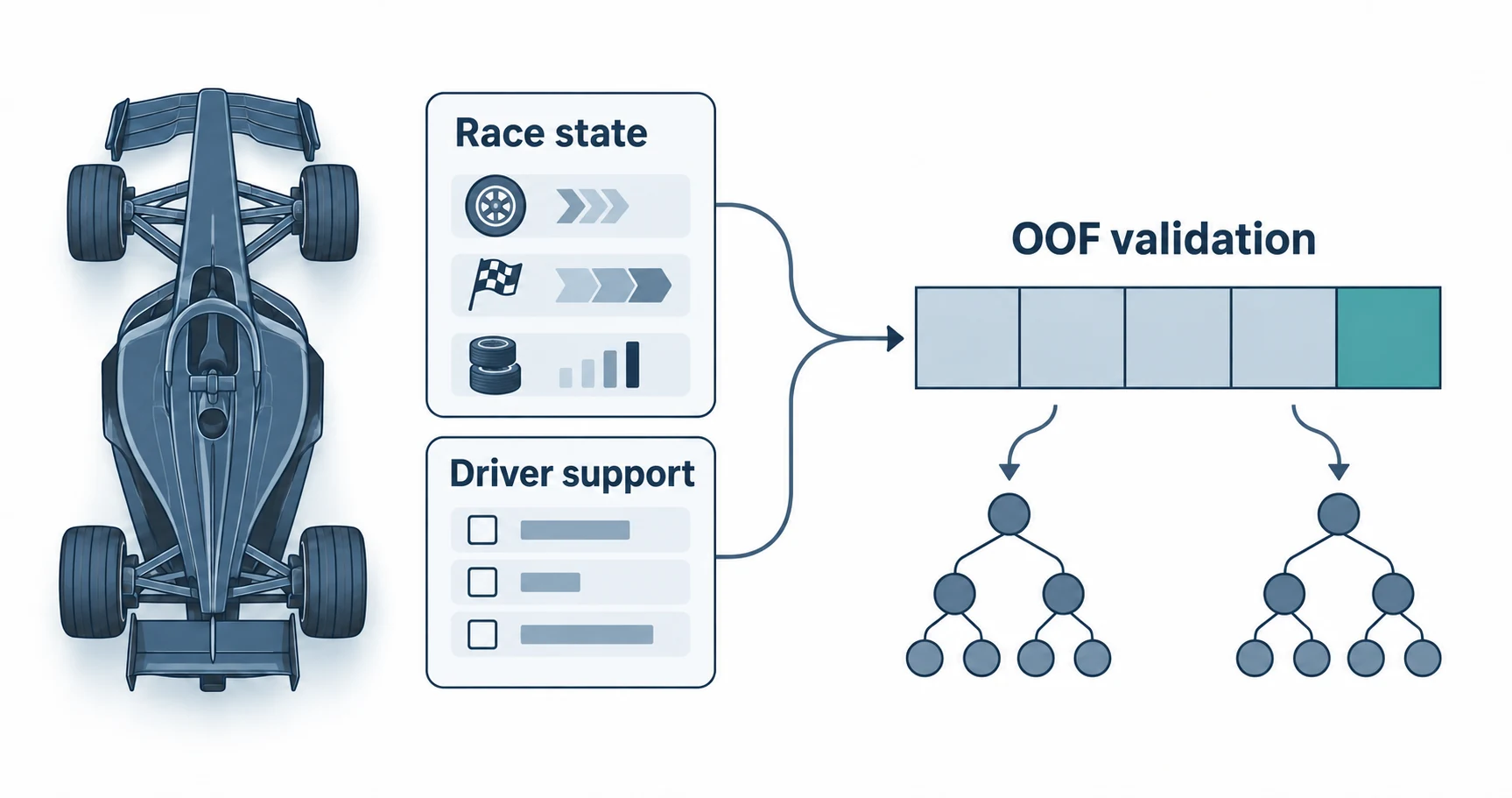
🏎️ S6E5 Driver’s High: Driver Feature Engineering
Kaggle notebook link:
S6E5 Driver’s High: Driver Feature Engineering
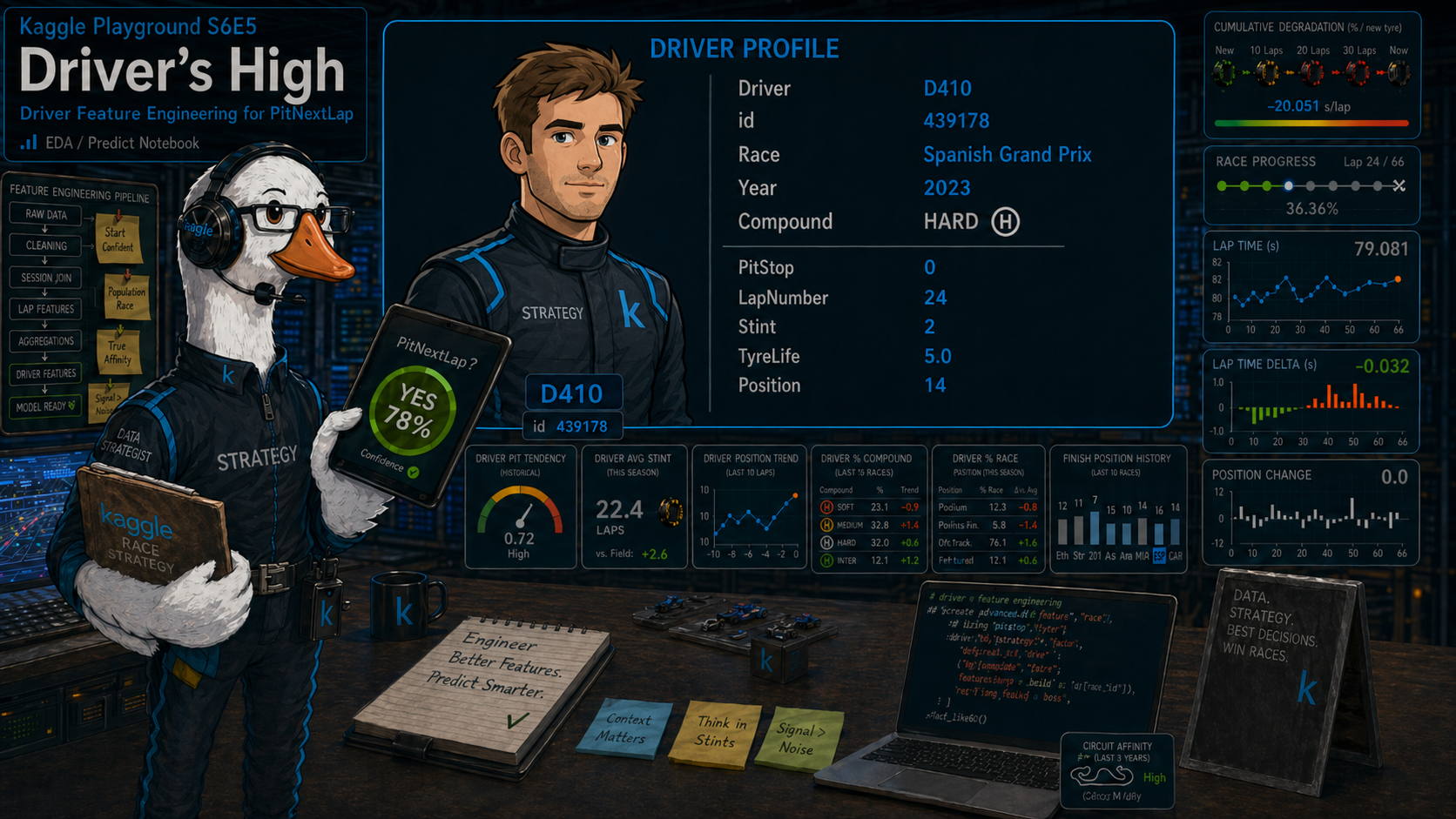
The central question of this notebook is narrow:
Does
Drivercontain measurable signal after race-state, tyre-state, compound, and stint information are already modeled?
In a pit-stop prediction problem, Driver is a tempting feature because it looks like a real strategic actor. But statistically, it is also a high-cardinality categorical variable. That means a strong result must distinguish between actual reusable signal and category memorization.
The notebook therefore treats Driver feature engineering as a sequence of controlled experiments:
\[\Delta_{\text{AUC}}(B) = \operatorname{AUC}\!\left(\hat p_{\text{base}+B}^{\text{oof}}, y\right) - \operatorname{AUC}\!\left(\hat p_{\text{counterfactual}}^{\text{oof}}, y\right)\]where each candidate block (B) is promoted only when it improves the correct counterfactual under the same OOF protocol.
1. The Modeling Question
The target is the probability of a pit stop on the next lap:
\[y_i = \begin{cases} 1, & \text{pit next lap} \\ 0, & \text{otherwise} \end{cases}\]The model produces:
\[\hat p_i = P(y_i = 1 \mid x_i)\]The score is ROC-AUC, which can be interpreted as a ranking probability:
\[\operatorname{AUC} = P(\hat p^+ > \hat p^-) + \frac{1}{2}P(\hat p^+ = \hat p^-)\]So the Driver question is not whether Driver changes the predicted probability for some rows. The question is whether Driver improves the relative ranking of positive and negative rows.
| Layer | Role | Statistical Risk |
|---|---|---|
| 🧱 Race-state foundation | lap, progress, stint, tyre age, degradation | underfitting if the physics-like state is too thin |
| 🛞 Compound and tyre pressure | tyre age relative to expected compound life | wrong scale if compound effects are treated as raw IDs only |
| 🧑✈️ Driver representation | string structure, frequency, target prior, interactions | high-cardinality leakage or memorization |
| 🧪 OOF protocol | same split, one changed block | false lift if validation rows encode their own target |
| 🧩 Stack / residual layer | compare Driver signal against stronger artifacts | over-crediting Driver when the real gain comes from model family or original data |
The key design choice is that Driver is not allowed to enter as one undifferentiated feature. It is split into progressively riskier representations.
2. Driver Inventory
The first diagnostic checks whether Driver behaves like a compact real-world categorical variable or a synthetic high-cardinality one.
| Dataset | Rows | Unique Drivers | D... Code Rate | 3-Letter Rate |
|---|---|---|---|---|
| Train | 439,140 | 887 | 59.58% | 40.42% |
| Test | 188,165 | 801 | 59.34% | 40.66% |
| Original | 101,371 | 31 | 0.00% | 100.00% |
This matters because the train/test data contain many D### style synthetic IDs, while the original data is made of 3-letter driver codes. The notebook therefore separates:
| Driver Signal | Meaning | Leakage Risk |
|---|---|---|
| 🧬 String structure | D### vs 3-letter code, numeric ID bins | low |
| 📚 Original vocabulary flag | whether Driver appears in the original data vocabulary | low to moderate |
| 📊 Frequency/support | number of rows behind Driver/Race contexts | low |
| 🎯 Target encoding | smoothed empirical pit-stop prior by category | high unless fold-safe |
| 🔀 Interaction target encoding | Driver-Compound, Race-Stint, Compound-Stint priors | higher variance |
The support distribution is also important:
| Threshold | Drivers | Covered Rows | Covered Row Rate |
|---|---|---|---|
>= 10 rows | 666 | 438,432 | 99.84% |
>= 50 rows | 535 | 435,485 | 99.17% |
>= 100 rows | 485 | 431,979 | 98.37% |
>= 250 rows | 411 | 419,501 | 95.53% |
>= 500 rows | 337 | 392,580 | 89.40% |
This makes frequency features statistically meaningful. Most rows are covered by drivers with enough support, but the long tail is still large enough that raw one-hot identity can overfit.
Show notebook snippet: data loading and Driver inventory
1
2
3
4
5
6
7
8
9
10
11
12
13
14
15
16
17
18
19
20
21
22
23
24
25
26
27
28
29
30
31
32
33
train = pd.read_csv(train_path)
test = pd.read_csv(test_path)
submission_template = pd.read_csv(submission_path)
original = pd.read_csv(original_path) if original_path is not None else None

TARGET = resolve_target_column(train, TARGET_CANDIDATES, "train")
SUBMISSION_TARGET = resolve_target_column(submission_template, TARGET_CANDIDATES, "sample_submission")

ID_COL = "id"
base_features = [col for col in test.columns if col != ID_COL]
raw_numeric_cols = [col for col in base_features if pd.api.types.is_numeric_dtype(train[col])]
raw_categorical_cols = [col for col in base_features if col not in raw_numeric_cols]
original_driver_set = set(original["Driver"].astype(str)) if original is not None and "Driver" in original else set()

driver_inventory = pd.DataFrame({
    "Dataset": ["Train", "Test", "Original" if original is not None else "Original missing"],
    "Rows": [len(train), len(test), len(original) if original is not None else 0],
    "Unique_Drivers": [
        train["Driver"].nunique(),
        test["Driver"].nunique(),
        original["Driver"].nunique() if original is not None else 0,
    ],
    "D_Code_Rate": [
        train["Driver"].astype(str).str.match(r"^D\d+$").mean(),
        test["Driver"].astype(str).str.match(r"^D\d+$").mean(),
        original["Driver"].astype(str).str.match(r"^D\d+$").mean() if original is not None else np.nan,
    ],
    "Three_Letter_Rate": [
        train["Driver"].astype(str).str.match(r"^[A-Z]{3}$").mean(),
        test["Driver"].astype(str).str.match(r"^[A-Z]{3}$").mean(),
        original["Driver"].astype(str).str.match(r"^[A-Z]{3}$").mean() if original is not None else np.nan,
    ],
})
3. Race-State Foundation
Before measuring Driver, the model needs a strong non-Driver baseline. The foundation translates raw lap rows into variables that better represent pit-stop pressure.
The first transformation estimates race length:
\[\widehat L_i = \frac{\text{LapNumber}_i}{\text{RaceProgress}_i}\]Then it derives remaining race state:
\[R_i = 1 - \text{RaceProgress}_i, \qquad \text{NormalizedTyreLife}_i = \frac{\text{TyreLife}_i}{\widehat L_i}\]Compound-specific tyre pressure is expressed as:
\[u_i = \frac{\text{TyreLife}_i}{E[\text{Life}\mid \text{Compound}_i]}\]and a pit-window indicator is:
\[\mathbb{1}\!\left(u_i \ge w_{\text{Compound}_i}\right)\]This makes the model compare tyre age on a compound-adjusted scale instead of treating all tyre life values as equivalent.
| Feature Block | Main Variables | Interpretation |
|---|---|---|
| 🏁 Race/tyre algebra | estimated race laps, laps remaining, normalized tyre life | race phase and tyre age scale |
| 🛞 Compound structure | hardness, dry/wet-like flags, tyre-life × hardness | compound-dependent wear pressure |
| ⏱️ Public domain features | pit window, degradation per lap, stop urgency | F1-inspired strategy pressure |
| 🔥 Nonlinear interactions | tyre life × progress, tyre life × stint, degradation × age | threshold-like pit behavior |
Show notebook snippet: race-state and compound feature blocks
1
2
3
4
5
6
7
8
9
10
11
12
13
14
15
16
17
18
19
20
21
22
23
24
25
26
27
28
29
30
31
32
33
34
35
36
37
38
39
40
41
42
43
44
45
46
47
48
49
50
COMPOUND_EXPECTED_LIFE = {
    "SOFT": 25.0,
    "MEDIUM": 35.0,
    "HARD": 45.0,
    "INTERMEDIATE": 30.0,
    "WET": 40.0,
}

COMPOUND_WINDOW_START = {
    "SOFT": 0.64,
    "MEDIUM": 0.68,
    "HARD": 0.72,
    "INTERMEDIATE": 0.62,
    "WET": 0.60,
}

def add_race_tyre_algebra(df):
    out = df.copy()
    estimated_laps = _safe_divide(
        out["LapNumber"].astype(float),
        out["RaceProgress"].astype(float),
    ).replace([np.inf, -np.inf], np.nan)

    out["EstimatedRaceLaps"] = estimated_laps.clip(lower=1, upper=120)
    out["LapsRemainingEstimate"] = (out["EstimatedRaceLaps"] - out["LapNumber"]).clip(lower=-10, upper=120)
    out["RemainingRaceProgress"] = (1.0 - out["RaceProgress"].astype(float)).clip(-0.1, 1.1)
    out["TyreLifeToLapNumber"] = _safe_divide(out["TyreLife"].astype(float), out["LapNumber"].astype(float))
    out["TyreLifeToRaceProgress"] = _safe_divide(out["TyreLife"].astype(float), out["RaceProgress"].astype(float))
    out["NormalizedTyreLifeEstimate"] = _safe_divide(out["TyreLife"].astype(float), out["EstimatedRaceLaps"].astype(float))
    return out

def add_public_domain_features(df):
    out = df.copy()
    expected_life = out["Compound"].astype(str).map(COMPOUND_EXPECTED_LIFE).fillna(35.0)
    window_start = out["Compound"].astype(str).map(COMPOUND_WINDOW_START).fillna(0.68)

    tyre_life = out["TyreLife"].astype(float)
    race_progress = out["RaceProgress"].astype(float).clip(0, 1.05)
    lap_delta = out["LapTime_Delta"].astype(float)
    cum_deg = out["Cumulative_Degradation"].astype(float)

    out["TyreLifePct"] = _safe_divide(tyre_life, expected_life).clip(0, 3)
    out["PitWindowStartPct"] = window_start
    out["InCompoundPitWindow"] = (out["TyreLifePct"] >= window_start).astype(int)
    out["WindowOvershootPct"] = (out["TyreLifePct"] - window_start).clip(lower=0, upper=2)
    out["DegPerLap"] = _safe_divide(cum_deg, tyre_life + 1.0)
    out["PositiveLapTimeDelta"] = lap_delta.clip(lower=0)
    out["AgeXDelta"] = tyre_life * out["PositiveLapTimeDelta"]
    out["StopUrgency"] = out["TyreLifePct"] * race_progress * (1.0 + 0.20 * out["Stint"].astype(float).clip(1, 4))
    return out
4. Driver Representation
The Driver feature ladder starts with the safest information and moves toward higher-risk encodings.
4.1 String Structure
The first compressed representation avoids raw one-hot identity:
\[\text{Driver} \mapsto \left[ \mathbb{1}_{D\text{-code}}, \mathbb{1}_{3\text{-letter}}, \text{DriverNum}, \text{DriverNumBin}, \mathbb{1}_{\text{missing num}} \right]\]This captures the synthetic-vs-original vocabulary structure without allocating one dummy variable per driver.
4.2 Frequency Encoding
For a categorical key (c), frequency encoding adds:
\[n(c) = \sum_i \mathbb{1}(x_i = c), \qquad f(c) = \log(1+n(c))\]and a rare-driver flag:
\[\mathbb{1}\{n(\text{Driver}) < 50\}\]This does not say that frequent drivers are inherently better. It tells the model how much support a category estimate has.
4.3 Context Normalization
Race-relative z-scores compare a row against its local context:
\[z_{i,g,v} = \frac{x_{i,v} - \mu_{g(i),v}}{\sigma_{g(i),v} + \epsilon}\]where (g(i)) can be Race, Race_Compound, Race_Lap, or Compound. This is useful because pit timing is not purely absolute. An old tyre on one race/lap context may be ordinary in another.
4.4 Target Encoding
For a category (c), the smoothed target prior is:
\[\operatorname{TE}(c) = \frac{\sum_{i:g_i=c} w_i y_i + \alpha \bar y} {\sum_{i:g_i=c} w_i + \alpha}\]The smoothing parameter (\alpha) controls shrinkage toward the global mean. Large (\alpha) is useful for small-support interactions such as Driver_Compound.
Show notebook snippet: Driver structure, count maps, and target encoding
1
2
3
4
5
6
7
8
9
10
11
12
13
14
15
16
17
18
19
20
21
22
23
24
25
26
27
28
29
30
31
32
33
34
35
36
37
38
39
40
41
42
43
44
45
46
def add_driver_structure(df):
    out = df.copy()
    driver = out["Driver"].astype(str)
    extracted = driver.str.extract(r"^D(\d+)$", expand=False)
    out["Driver_is_D_code"] = driver.str.match(r"^D\d+$").astype(int)
    out["Driver_is_3letter"] = driver.str.match(r"^[A-Z]{3}$").astype(int)
    out["Driver_num"] = pd.to_numeric(extracted, errors="coerce").fillna(-1)
    out["Driver_num_missing"] = (out["Driver_num"] < 0).astype(int)
    bins = [-2, -0.5, 99, 199, 399, 699, 9999]
    out["Driver_num_bin"] = pd.cut(out["Driver_num"], bins=bins, labels=False, include_lowest=True).astype(float)
    return out

def fit_count_maps(fit_df, columns, weight=None):
    w = np.ones(len(fit_df), dtype=float) if weight is None else np.asarray(weight, dtype=float)
    maps = {}
    for col in columns:
        tmp = pd.DataFrame({col: fit_df[col].astype(str), "__w": w})
        maps[col] = tmp.groupby(col, observed=True)["__w"].sum()
    return maps

def apply_count_maps(df, count_maps):
    out = df.copy()
    for col, counts in count_maps.items():
        mapped = out[col].astype(str).map(counts).fillna(0).astype(float)
        out[f"{col}_count"] = mapped
        out[f"{col}_freq_log1p"] = np.log1p(mapped)
        if col == "Driver":
            out["Driver_is_rare_50"] = (mapped < 50).astype(int)
    return out

def fit_target_maps(fit_df, columns, target, weight=None, alpha=80):
    y = fit_df[target].astype(float).to_numpy()
    w = np.ones(len(fit_df), dtype=float) if weight is None else np.asarray(weight, dtype=float)
    prior = np.average(y, weights=w)
    maps = {}
    tmp = fit_df.copy()
    tmp["__y"] = y
    tmp["__w"] = w
    tmp["__yw"] = y * w
    for col in columns:
        grouped = tmp.groupby(col, observed=True).agg(
            weight_sum=("__w", "sum"),
            target_sum=("__yw", "sum"),
        )
        maps[col] = ((grouped["target_sum"] + alpha * prior) / (grouped["weight_sum"] + alpha)).to_dict()
    return maps, prior
5. Fold-Safe Validation
The most important implementation detail is that all fitted transformations are learned inside the fold.
For fold (k):
\[\mathcal{D}_{-k} = \text{training rows outside fold } k, \qquad \mathcal{D}_{k} = \text{validation rows inside fold } k\]Then any fitted encoder (T_k) must satisfy:
\[T_k = \operatorname{fit}(\mathcal{D}_{-k}), \qquad X_k^{\text{valid}} = T_k(\mathcal{D}_k)\]For target encoding, the training side itself also needs an inner OOF encoding. Otherwise a row can encode its own target.
\[\hat z_i = \operatorname{TE}_{-h(i)}(x_i)\]where (h(i)) is the inner fold containing row (i).
Show notebook snippet: fold-safe feature fitting and OOF runner
1
2
3
4
5
6
7
8
9
10
11
12
13
14
15
16
17
18
19
20
21
22
23
24
25
26
27
28
29
30
31
32
33
34
35
36
37
38
39
40
41
42
43
44
45
46
47
48
49
50
51
52
53
54
55
56
57
58
59
60
61
62
63
64
65
66
67
68
69
70
71
72
73
74
75
76
77
78
79
80
81
82
83
84
85
86
87
def fit_fold_features(fit_df, valid_df, test_df, blocks, target, fit_weight=None):
    fit_x = prepare_static_features(fit_df, blocks)
    valid_x = prepare_static_features(valid_df, blocks)
    test_x = prepare_static_features(test_df, blocks)

    if "frequency_encoding" in blocks:
        count_maps = fit_count_maps(fit_x, FREQUENCY_COLUMNS, weight=fit_weight)
        fit_x = apply_count_maps(fit_x, count_maps)
        valid_x = apply_count_maps(valid_x, count_maps)
        test_x = apply_count_maps(test_x, count_maps)

    if "context_normalization" in blocks:
        value_cols = sorted({value for values in CONTEXT_GROUP_SPECS.values() for value in values})
        global_stats = fit_global_stats(fit_x, value_cols, weight=fit_weight)
        group_stats = fit_group_stats(fit_x, CONTEXT_GROUP_SPECS, weight=fit_weight)
        fit_x = apply_group_stats(fit_x, group_stats, global_stats)
        valid_x = apply_group_stats(valid_x, group_stats, global_stats)
        test_x = apply_group_stats(test_x, group_stats, global_stats)

    if "oof_target_encoding" in blocks:
        fit_x = add_inner_oof_target_encoding(
            fit_x,
            target=target,
            columns=TARGET_ENCODING_COLUMNS,
            sample_weight=fit_weight,
            alpha=80,
            n_splits=INNER_TE_SPLITS,
            suffix="te",
        )
        maps, prior = fit_target_maps(fit_x, TARGET_ENCODING_COLUMNS, target, fit_weight, alpha=80)
        valid_x = apply_target_maps(valid_x, maps, prior, suffix="te")
        test_x = apply_target_maps(test_x, maps, prior, suffix="te")

    return fit_x, valid_x, test_x

def run_oof_experiment(config, train_frame=None, test_frame=None, verbose=True):
    train_frame = cv_train if train_frame is None else train_frame
    test_frame = test if test_frame is None else test_frame
    y = train_frame[TARGET].astype(int).to_numpy()
    skf = StratifiedKFold(n_splits=N_SPLITS, shuffle=True, random_state=RANDOM_STATE)

    oof = np.zeros(len(train_frame), dtype=float)
    test_pred = np.zeros(len(test_frame), dtype=float)

    for fold, (fit_idx, valid_idx) in enumerate(skf.split(train_frame, y), start=1):
        fold_fit = train_frame.iloc[fit_idx].copy()
        fold_valid = train_frame.iloc[valid_idx].copy()

        fit_x, valid_x, test_x = fit_fold_features(
            fold_fit,
            fold_valid,
            test_frame,
            config.blocks,
            TARGET,
        )

        numeric_features = select_numeric_features(config.blocks, available_columns=fit_x.columns)
        preprocessor = build_preprocessor(
            numeric_features=numeric_features,
            categorical_features=select_categorical_features(config.include_driver_ohe),
            scale_numeric=(config.model_kind == "logreg"),
        )

        X_fit = preprocessor.fit_transform(fit_x)
        X_valid = preprocessor.transform(valid_x)
        X_test = preprocessor.transform(test_x)

        model = make_model(config.model_kind)
        valid_pred, fold_test_pred, fitted_model = fit_predict_model(
            config.model_kind,
            model,
            X_fit,
            fold_fit[TARGET].astype(int).to_numpy(),
            X_valid,
            fold_valid[TARGET].astype(int).to_numpy(),
            X_test,
        )
        oof[valid_idx] = valid_pred
        test_pred += fold_test_pred / N_SPLITS

    return {
        "config": config,
        "oof": oof,
        "test_pred": test_pred,
        "auc": roc_auc_score(y, oof),
        "logloss": log_loss(y, np.clip(oof, 1e-6, 1 - 1e-6)),
    }
6. Driver Ladder Results
The Driver ladder is split into two branches:
| Branch | Question | Counterfactual |
|---|---|---|
| 🧑✈️ Raw identity ladder | Does Driver one-hot help directly? | no-Driver race-state foundation |
| 🧬 Compressed ladder | Can Driver signal survive without raw OHE? | same foundation, adding one Driver representation at a time |
| 🔀 Interaction branch | Are Driver/compound/stint priors stable? | the B04 target-encoding parent |
6.1 Raw Driver OHE
| Experiment | Added Block | OOF AUC | Delta vs No Driver |
|---|---|---|---|
A00_no_driver | Race-state foundation without raw Driver ID | 0.946243 | 0.000000 |
A01_driver_ohe | Add raw Driver one-hot identity | 0.945964 | -0.000279 |
Raw Driver identity did not improve this saved CV run. This is an important negative result because it prevents the notebook from over-trusting a high-cardinality ID.
6.2 Compressed Driver Signal
| Experiment | Added Block | OOF AUC | Delta vs No Driver | CV Read |
|---|---|---|---|---|
B00_no_driver | Race-state foundation | 0.946243 | 0.000000 | baseline |
B01_driver_string | Driver string structure | 0.946691 | +0.000448 | improves |
B02_original_vocab | original-driver vocabulary flag | 0.946586 | +0.000343 | below previous |
B03_driver_frequency | Driver/Race frequency features | 0.946818 | +0.000575 | best compressed step |
B04_driver_te | inner-OOF Driver/Race target encoding | 0.946670 | +0.000427 | below previous |
The best saved Driver representation is:
\[\texttt{B03\_driver\_frequency}\]with:
\[\Delta_{\text{AUC}} = 0.946818 - 0.946243 = 0.000575\]That is small, but it is directionally consistent in the paired bootstrap:
| Comparison | Mean Delta | P05 | Median | P95 | Probability Positive |
|---|---|---|---|---|---|
B03_driver_frequency - B00 | 0.000573 | 0.000384 | 0.000572 | 0.000764 | 1.000 |
6.3 Interaction Target Encoding
Interaction TE did not beat the B04_driver_te parent:
| Experiment | Parent | Delta vs Parent | Decision |
|---|---|---|---|
B05_driver_compound_te | B04_driver_te | -0.000261 | reject |
B06_race_compound_te | B04_driver_te | -0.000076 | reject |
B07_race_stint_te | B04_driver_te | -0.000143 | reject |
B08_compound_stint_te | B04_driver_te | -0.000125 | reject |
This is the expected failure mode for sparse interactions. The conditional prior is conceptually reasonable, but the sample support is thinner and the variance penalty dominates.
Show notebook snippet: Driver ladder configuration and bootstrap check
1
2
3
4
5
6
7
8
9
10
11
12
13
14
15
16
17
18
19
20
21
22
23
24
25
26
27
28
29
30
31
32
33
34
35
36
37
38
39
40
41
42
43
44
45
46
47
48
49
50
51
52
53
54
55
56
57
58
59
60
61
62
63
64
65
66
67
68
69
70
71
72
73
74
75
76
77
DRIVER_FOUNDATION_BLOCKS = [
    "race_tyre_algebra",
    "compound_structure",
    "nonlinear_interactions",
]

identity_driver_configs = [
    ExperimentConfig(
        "A00_no_driver",
        "Race-state foundation without raw Driver ID",
        DRIVER_FOUNDATION_BLOCKS,
        include_driver_ohe=False,
        model_kind=LADDER_MODEL,
    ),
    ExperimentConfig(
        "A01_driver_ohe",
        "Add raw Driver one-hot identity",
        DRIVER_FOUNDATION_BLOCKS,
        include_driver_ohe=True,
        model_kind=LADDER_MODEL,
    ),
]

compressed_driver_configs = [
    ExperimentConfig(
        "B00_no_driver",
        "Race-state foundation without raw Driver ID",
        DRIVER_FOUNDATION_BLOCKS,
        include_driver_ohe=False,
        model_kind=LADDER_MODEL,
    ),
    ExperimentConfig(
        "B01_driver_string",
        "Driver string structure without raw OHE",
        DRIVER_FOUNDATION_BLOCKS + ["driver_structure"],
        include_driver_ohe=False,
        model_kind=LADDER_MODEL,
    ),
    ExperimentConfig(
        "B03_driver_frequency",
        "Add Driver/Race frequency features",
        DRIVER_FOUNDATION_BLOCKS + ["driver_structure", "driver_original_vocab", "frequency_encoding"],
        include_driver_ohe=False,
        model_kind=LADDER_MODEL,
    ),
    ExperimentConfig(
        "B04_driver_te",
        "Add inner-OOF Driver/Race target encoding",
        DRIVER_FOUNDATION_BLOCKS + ["driver_structure", "driver_original_vocab", "frequency_encoding", "oof_target_encoding"],
        include_driver_ohe=False,
        model_kind=LADDER_MODEL,
    ),
]

def paired_auc_delta_bootstrap(y, pred_a, pred_b, comparison, n_boot=800, seed=RANDOM_STATE):
    rng = np.random.default_rng(seed)
    y = np.asarray(y)
    pred_a = np.asarray(pred_a)
    pred_b = np.asarray(pred_b)
    deltas = []

    for _ in range(n_boot):
        idx = rng.integers(0, len(y), size=len(y))
        if len(np.unique(y[idx])) < 2:
            continue
        deltas.append(roc_auc_score(y[idx], pred_b[idx]) - roc_auc_score(y[idx], pred_a[idx]))

    deltas = np.asarray(deltas, dtype=float)
    return pd.DataFrame([{
        "Comparison": comparison,
        "Mean_Delta": deltas.mean(),
        "P05": np.quantile(deltas, 0.05),
        "Median": np.quantile(deltas, 0.50),
        "P95": np.quantile(deltas, 0.95),
        "Prob_Positive": np.mean(deltas > 0),
        "Bootstraps": len(deltas),
    }])
7. Score-Oriented Candidate Stack
After the Driver ladder, the notebook tests whether public-stack style preprocessing beats the current Driver-frequency selection.
Two matrix styles are compared:
| Candidate | Feature Count | OOF AUC | Delta vs Current Best |
|---|---|---|---|
S05_stack_core_preprocessing | 35 | 0.944899 | -0.0019 |
S06_stack_domain_preprocessing | 111 | 0.946050 | -0.0008 |
The larger domain matrix improves over the core matrix, but neither beats B03_driver_frequency in this local LGBM run. The interpretation is not that sequence/group features are bad. It is that their value appears more compatible with the heavier XGB/Cat/LGBM stack than with the saved lightweight ladder.
The score gap table makes this explicit:
| Model or Stack | Reference OOF AUC | Gap vs B03_driver_frequency | Read |
|---|---|---|---|
B03_driver_frequency | 0.946818 | 0.000000 | current local best |
| Domain LGBM public reference | 0.948120 | +0.001302 | small improvement |
| RealMLP public reference | 0.949510 | +0.002692 | small improvement |
| XGB baseline + original | 0.958160 | +0.011342 | leaderboard-scale gap |
| XGB Optuna + original | 0.959940 | +0.013122 | leaderboard-scale gap |
| XGB + CatBoost ensemble | 0.960760 | +0.013942 | leaderboard-scale gap |
This reframes Driver as an auxiliary signal. The largest score movement is coming from model family, original data usage, and ensemble structure.
Show notebook snippet: stack preprocessing candidates
1
2
3
4
5
6
7
8
9
10
11
12
13
14
15
16
17
18
19
20
21
22
23
24
25
26
27
28
29
30
31
32
33
34
35
36
37
38
39
40
41
42
43
44
45
46
47
48
49
50
51
52
53
54
55
56
57
58
59
60
61
62
63
64
SCORE_FOUNDATION_BLOCKS = [
    "race_tyre_algebra",
    "compound_structure",
    "public_domain_features",
    "nonlinear_interactions",
]

SCORE_SAFE_DRIVER_BLOCKS = SCORE_FOUNDATION_BLOCKS + [
    "driver_structure",
    "driver_original_vocab",
    "frequency_encoding",
    "context_normalization",
]

score_candidate_configs = [
    ExperimentConfig(
        "S00_driver_ohe_domain",
        "Driver OHE + public pit-window domain features",
        SCORE_FOUNDATION_BLOCKS,
        include_driver_ohe=True,
        model_kind=LADDER_MODEL,
    ),
    ExperimentConfig(
        "S01_driver_ohe_context",
        "Add weighted support and field-relative context",
        SCORE_SAFE_DRIVER_BLOCKS,
        include_driver_ohe=True,
        model_kind=LADDER_MODEL,
    ),
    ExperimentConfig(
        "S02_driver_ohe_driver_te",
        "Add inner-OOF Driver/Race target encoding",
        SCORE_SAFE_DRIVER_BLOCKS + ["oof_target_encoding"],
        include_driver_ohe=True,
        model_kind=LADDER_MODEL,
    ),
]

def add_stack_domain_features(train_df, test_df):
    train_base = add_stack_row_features(train_df)
    test_base = add_stack_row_features(test_df)
    train_base["__part"] = "train"
    test_base["__part"] = "test"
    train_base["__row"] = np.arange(len(train_base))
    test_base["__row"] = np.arange(len(test_base))
    full = pd.concat([train_base, test_base], ignore_index=True, sort=False)

    sort_cols = [col for col in ["Race", "Driver", "Year", "Stint", "LapNumber"] if col in full.columns]
    full = full.sort_values(sort_cols).copy()
    group_cols = [col for col in ["Race", "Driver", "Year", "Stint"] if col in full.columns]
    g = full.groupby(group_cols, sort=False, observed=True)

    full["stack_lap_in_stint"] = g.cumcount() + 1
    full["stack_stint_len"] = g["LapNumber"].transform("count")
    full["stack_pos_prev1"] = g["Position"].shift(1)
    full["stack_pos_delta1"] = full["Position"] - full["stack_pos_prev1"]
    full["stack_lt_prev1"] = g["LapTime (s)"].shift(1)
    full["stack_lt_delta1"] = full["LapTime (s)"] - full["stack_lt_prev1"]
    full["stack_tyre_life_lag1"] = g["TyreLife"].shift(1)
    full["stack_tyre_life_diff1"] = full["TyreLife"] - full["stack_tyre_life_lag1"]
    full["stack_race_lap_meantyrelife"] = full.groupby(["Race", "LapNumber"], observed=True)["TyreLife"].transform("mean")
    full["stack_tyrelife_vs_field_mean"] = full["TyreLife"] - full["stack_race_lap_meantyrelife"]

    return full
8. Driver As A Residual Correction
The second Driver hypothesis is subtler:
Driver may be too weak as a main feature, but still useful as a post-model calibration bias.
The residual layer works in logit space. For a base prediction (\hat p_i):
\[\operatorname{logit}(\hat p_i) = \log \frac{\hat p_i}{1-\hat p_i}\]For a Driver group (g), the notebook estimates a smoothed observed rate and a smoothed predicted rate:
\[\tilde y_g = \frac{\sum_{i:g_i=g} y_i + \alpha \bar y}{n_g+\alpha}, \qquad \tilde p_g = \frac{\sum_{i:g_i=g} \hat p_i + \alpha \bar p}{n_g+\alpha}\]The group residual is:
\[\delta_g = \operatorname{logit}(\tilde y_g) - \operatorname{logit}(\tilde p_g)\]Then the corrected prediction is:
\[\hat p'_i = \sigma\!\left( \operatorname{logit}(\hat p_i) + \lambda \sum_{g \in G_i} w_g\delta_g \right)\]where (\lambda) is selected by OOF AUC.
The saved local residual table:
| Experiment | Groups | Lambda | OOF AUC | Delta vs Base | Decision |
|---|---|---|---|---|---|
R00_base_selected_stack | none | 0.00 | 0.946818 | 0.000000 | base |
R01_driver_logit_bias | Driver | -0.25 | 0.946820 | +0.000002 | watchlist |
R02_driver_phase_logit_bias | Driver + Driver_Phase | -0.25 | 0.946820 | +0.000002 | watchlist |
R05_driver_strategy_logit_bias | Driver + phase + compound + stint | -0.10 | 0.946819 | +0.000001 | watchlist |
The promotion threshold is:
\[\Delta_{\text{AUC}} \ge 0.0003\]The local residual gains are far below that threshold, so they remain watchlist signals rather than final candidates.
Show notebook snippet: logit residual correction
1
2
3
4
5
6
7
8
9
10
11
12
13
14
15
16
17
18
19
20
21
22
23
24
25
26
27
28
29
30
31
32
33
34
35
36
37
38
39
40
41
42
43
44
45
46
47
48
49
50
51
52
53
54
55
56
57
58
59
60
61
62
def logit_clip(p, eps=1e-6):
    p = np.clip(np.asarray(p, dtype=float), eps, 1 - eps)
    return np.log(p / (1 - p))

def fit_logit_residual_maps(residual_frame, y, base_pred, group_alphas):
    maps = {}
    y = np.asarray(y, dtype=float)
    base_pred = np.clip(np.asarray(base_pred, dtype=float), 1e-6, 1 - 1e-6)
    global_y = float(np.mean(y))
    global_p = float(np.mean(base_pred))

    for col, alpha in group_alphas.items():
        tmp = pd.DataFrame({
            "key": residual_frame[col].astype(str),
            "y": y,
            "p": base_pred,
        })
        grouped = tmp.groupby("key", observed=True).agg(
            n=("y", "size"),
            y_sum=("y", "sum"),
            p_sum=("p", "sum"),
        )
        grouped["y_smooth"] = (grouped["y_sum"] + alpha * global_y) / (grouped["n"] + alpha)
        grouped["p_smooth"] = (grouped["p_sum"] + alpha * global_p) / (grouped["n"] + alpha)
        grouped["delta_logit"] = logit_clip(grouped["y_smooth"]) - logit_clip(grouped["p_smooth"])
        maps[col] = grouped[["delta_logit", "n"]]
    return maps

def evaluate_logit_residual_spec(spec, train_resid_frame, test_resid_frame, y, base_oof, base_test):
    skf = StratifiedKFold(n_splits=N_SPLITS, shuffle=True, random_state=RANDOM_STATE + 100)
    delta_oof = np.zeros(len(train_resid_frame), dtype=float)
    delta_test = np.zeros(len(test_resid_frame), dtype=float)

    for fold, (fit_idx, valid_idx) in enumerate(skf.split(train_resid_frame, y), start=1):
        maps = fit_logit_residual_maps(
            train_resid_frame.iloc[fit_idx],
            y[fit_idx],
            base_oof[fit_idx],
            spec["alphas"],
        )
        delta_oof[valid_idx] = apply_logit_residual_signal(
            train_resid_frame.iloc[valid_idx],
            maps,
            spec["groups"],
        )
        delta_test += apply_logit_residual_signal(test_resid_frame, maps, spec["groups"]) / N_SPLITS

    base_logit_oof = logit_clip(base_oof)
    lambda_grid = np.array([-1.00, -0.75, -0.50, -0.25, -0.10, 0.0, 0.10, 0.25, 0.50, 0.75, 1.00])

    rows = []
    for lam in lambda_grid:
        corrected_oof = sigmoid_array(base_logit_oof + lam * delta_oof)
        rows.append({
            "Lambda": lam,
            "OOF_AUC": roc_auc_score(y, corrected_oof),
        })

    strength_table = pd.DataFrame(rows)
    best_lambda = float(strength_table.loc[strength_table["OOF_AUC"].idxmax(), "Lambda"])
    corrected_oof = sigmoid_array(base_logit_oof + best_lambda * delta_oof)
    return corrected_oof, strength_table
9. Heavy-Stack Overlay
The final section attaches stronger OOF/test artifacts and asks whether Driver residuals add value on top of the real scoring base.
The stack search uses probability and rank blends:
\[\hat p^{\text{prob}}_i = \sum_{m=1}^{M} w_m \hat p_{im}, \qquad w_m \ge 0,\quad \sum_m w_m = 1\]For rank blending:
\[\hat r_i = \sum_{m=1}^{M} w_m \operatorname{rank}_{01}(\hat p_{im})\]The discovered base models had these OOF scores:
| Model | OOF AUC |
|---|---|
realmlp_full_fullrows_5fold | 0.952177 |
lgb_domain_w07_full_fullrows_10fold | 0.950665 |
xgb_core_w1_full_fullrows_10fold | 0.950331 |
cat_core_w1_full_fullrows_10fold | 0.949682 |
xgb_public_te_w1_full_fullrows_10fold | 0.949381 |
The selected heavy-stack artifact reached:
\[\operatorname{AUC}_{\text{heavy stack}} \approx 0.953404\]The Driver residual overlay reached about:
\[0.953409\]but the improvement was not large enough to beat the promotion threshold. So the final blend assigned all weight to the heavy-stack artifact:
| Model | Blend Weight |
|---|---|
B03_driver_frequency | 0.000 |
H00_heavy_stack_artifact | 1.000 |
This is a useful outcome. It says Driver frequency is a valid local signal, but once stronger full-row stack predictions are available, Driver residuals do not yet justify replacing the artifact base.
Show notebook snippet: artifact blending and heavy-stack residual overlay
1
2
3
4
5
6
7
8
9
10
11
12
13
14
15
16
17
18
19
20
21
22
23
24
25
26
27
28
29
30
31
32
33
34
35
36
37
38
39
40
41
42
43
44
45
46
47
48
49
50
51
52
53
54
55
56
57
58
59
60
61
62
63
64
65
66
67
68
69
70
71
72
73
74
75
76
77
78
79
80
81
82
def rank01_np(values):
    values = np.asarray(values, dtype=float)
    order = np.argsort(values, kind="mergesort")
    ranks = np.empty(len(values), dtype=float)
    ranks[order] = np.arange(1, len(values) + 1)
    return ranks / (len(values) + 1)

def simplex_grid(n, step):
    units = int(round(1 / step))
    current = []

    def rec(left, slots):
        if slots == 1:
            yield current + [left]
        else:
            for value in range(left + 1):
                current.append(value)
                yield from rec(left - value, slots - 1)
                current.pop()

    for parts in rec(units, n):
        yield np.array(parts, dtype=float) / units

def search_stack_base_blends(names, oof_matrix, test_matrix, y):
    rank_oof = np.column_stack([rank01_np(oof_matrix[:, idx]) for idx in range(oof_matrix.shape[1])])
    rank_test = np.column_stack([rank01_np(test_matrix[:, idx]) for idx in range(test_matrix.shape[1])])
    candidates = []

    for mode, matrix_oof, matrix_test in [
        ("probability", oof_matrix, test_matrix),
        ("rank", rank_oof, rank_test),
    ]:
        best_auc = -np.inf
        best_weights = None
        best_oof = None
        best_test = None

        for weights in simplex_grid(len(names), STACK_BLEND_GRID_STEP):
            pred = matrix_oof @ weights
            auc = roc_auc_score(y, pred)
            if auc > best_auc:
                best_auc = auc
                best_weights = weights.copy()
                best_oof = pred
                best_test = matrix_test @ weights

        candidates.append({
            "Mode": mode,
            "OOF_AUC": best_auc,
            "Weights": best_weights,
            "OOF": best_oof,
            "Test": best_test,
        })

    best_candidate = max(candidates, key=lambda item: item["OOF_AUC"])
    probability_candidate = next(item for item in candidates if item["Mode"] == "probability")
    return best_candidate, probability_candidate

def run_heavy_stack_residual_overlay(stack_train_frame, stack_test_frame, y, probability_base, best_artifact_base):
    spec_results = [
        evaluate_logit_residual_spec(
            spec,
            build_residual_frame(stack_train_frame),
            build_residual_frame(stack_test_frame),
            y,
            np.clip(probability_base["OOF"], 1e-6, 1 - 1e-6),
            np.clip(probability_base["Test"], 1e-6, 1 - 1e-6),
        )
        for spec in RESIDUAL_SPECS
    ]

    best_residual = max(spec_results, key=lambda item: item["auc"])
    if best_residual["auc"] >= best_artifact_base["OOF_AUC"] + RESIDUAL_PROMOTION_MIN_AUC:
        selected_oof = best_residual["oof"]
        selected_test = best_residual["test_pred"]
        selected_decision = "promoted residual"
    else:
        selected_oof = best_artifact_base["OOF"]
        selected_test = best_artifact_base["Test"]
        selected_decision = "artifact base"

    return selected_oof, selected_test, selected_decision
10. Final Submission Logic
The final file is a standard probability submission. The notebook checks row count, ID alignment, probability bounds, and missing values:
\[0 \le \hat p_i \le 1\]The saved output summary:
| Rows | Mean Prediction | Min Prediction | Max Prediction | Filename |
|---|---|---|---|---|
| 188,165 | 0.1982 | 0.0001 | 0.9954 | submission.csv |
Show notebook snippet: final submission checks
1
2
3
4
5
6
7
8
9
10
11
12
13
14
15
16
17
submission = submission_template.copy()
submission[SUBMISSION_TARGET] = np.clip(blend_test, 0, 1)

assert submission.shape[0] == test.shape[0]
assert submission[ID_COL].equals(test[ID_COL])
assert submission[SUBMISSION_TARGET].between(0, 1).all()
assert submission[SUBMISSION_TARGET].isna().sum() == 0

submission.to_csv(SUBMISSION_FILENAME, index=False)

submission_summary = pd.DataFrame({
    "Rows": [len(submission)],
    "Mean_Prediction": [submission[SUBMISSION_TARGET].mean()],
    "Min_Prediction": [submission[SUBMISSION_TARGET].min()],
    "Max_Prediction": [submission[SUBMISSION_TARGET].max()],
    "Filename": [SUBMISSION_FILENAME],
})
11. What The Notebook Establishes
The most useful conclusion is not simply “Driver helps” or “Driver does not help.” The more precise reading is:
| Claim | Evidence | Decision |
|---|---|---|
| Raw Driver one-hot is not enough | A01 - A00 = -0.000279 AUC | reject in saved CV |
| Compressed Driver support is useful | B03 - B00 = +0.000575 AUC | keep as local signal |
| Target encoding needs strict guardrails | B04 falls below B03 | do not promote by complexity alone |
| Interaction TE is high variance | all tested interactions fall below the parent | reject interaction branches |
| Public-style stack features need stronger models | local LGBM stack candidates trail B03 | keep for heavier stack |
| Driver residual is not promoted | gains are around a few (10^{-6}) AUC | watchlist only |
| Heavy-stack artifact dominates final blend | selected blend weight is 1.0 on artifact stack | final submission base |
11.1 Statistical Meaning Of The Conclusion
The conclusion should not be read as a causal claim about driver skill. The notebook does not establish that a particular driver is intrinsically better at pit strategy. What it establishes is narrower:
After race-state, tyre-state, compound, stint, and degradation features are already present, Driver-derived support and frequency variables still contain a small amount of additional OOF ranking signal.
The relevant marginal effect is:
\[\Delta_{\text{Driver frequency}} = \operatorname{AUC}(\text{race-state} + \text{Driver frequency}) - \operatorname{AUC}(\text{race-state only})\]In the saved run:
\[\Delta_{\text{Driver frequency}} = 0.946818 - 0.946243 = 0.000575\]So the statistically careful interpretation is:
Driver frequency has small marginal predictive utility under the controlled OOF protocol.
This is different from saying that raw Driver identity is useful. Raw one-hot Driver identity moved in the wrong direction:
\[\Delta_{\text{raw Driver OHE}} = 0.945964 - 0.946243 = -0.000279\]That negative result matters. It suggests that a high-cardinality Driver ID can increase variance or memorize unstable category effects, while lower-variance summaries such as support counts and frequency logs are more robust.
Statistically, the surviving Driver signal is closer to a support-size / reliability proxy than a direct identity effect:
\[\text{Driver} \not\Rightarrow \text{skill claim} \qquad \text{Driver frequency} \Rightarrow \text{category support and generator-context signal}\]The residual-correction result gives the second half of the interpretation. Once the stronger stack artifact is used as the base, Driver residual corrections do not clear the promotion threshold:
\[\operatorname{AUC}_{\text{corrected}} - \operatorname{AUC}_{\text{base}} < 0.0003\]This means the small Driver signal is either already absorbed by the stronger model stack or too weak to survive as an independent post-stack correction. Therefore, Driver is best interpreted as a low-amplitude auxiliary feature, not as a primary modeling axis.
The notebook’s statistical structure is therefore:
\[\text{Driver ID} \rightarrow \text{Driver compression} \rightarrow \text{fold-safe Driver prior} \rightarrow \text{residual Driver correction} \rightarrow \text{heavy-stack comparison}\]The important part is the counterfactual discipline. Every Driver idea must answer:
\[\operatorname{AUC}_{\text{candidate}} - \operatorname{AUC}_{\text{matching counterfactual}} > 0\]and for residual overlays:
\[\operatorname{AUC}_{\text{corrected}} - \operatorname{AUC}_{\text{base}} \ge 0.0003\]That is why the final interpretation is conservative:
Driver frequency survives as a small, measurable signal. Driver residual correction does not yet survive promotion once the stronger stack artifact is the base.