BioHub Cell Tracking Working Note 4: Three Gaps in Local Validation
Series links and references
- Competition: BioHub - Cell Tracking During Development
- Official metric notes: RoyerLab kaggle-cell-tracking-competition metrics.md
- Previous notes:
- Korean version: BioHub Cell Tracking 작업 기록 4: 로컬 검증에서 발견한 세 가지 빈틈
- Follow-up: BioHub Cell Tracking Working Note 5: What a Frozen Graph Left Untested
Related public notebooks
About this series. BioHub asks competitors to reconstruct cell lineage graphs from 3D microscopy movies. The labeled training set contains 199 movies from two embryos; Public scores cover 29% of the hidden test set, and Private scores cover the remaining 71%. The hidden test comes from embryos not seen in training. Each note follows the record through its stated period; later findings and retrospective comments are marked separately.
Later context — September 23, 2026. The September 2 audit traced the +0.0144 and +0.0313 results to mixed-embryo policy folds; Section 3 uses that finding to explain the distinction from the August protocol changes. Public differences within ±0.002 are read as ties under the September 5–6 rule, with differences of about 0.003 or more prompting investigation.
July left seven reference graphs unreconciled. The August record contained three gaps in local validation: the reverse-association submission scored \(0.913\) against a written expectation of \(0.918\); a separate composition used folds that mixed the embryos; and a detection diagnostic used movies the deployed model had trained on. The fold construction was traced later, as noted above. Neither it nor the hold-in diagnostic explained the first discrepancy.
The useful outcome was a change in what I asked of evidence: compare complete matched pipelines, hold out the domain that will change at test time, and trace a diagnostic back to the data used to fit its models. The record also includes twenty-eight early-August submissions, before the more restrictive Public policy took shape.
0. What Local Evidence Measures, and How the Board Is Read
Almost every local number here comes from the research replay: each of the 199 training movies is predicted by the fold model trained on the other embryo, the full graph construction is replayed, and the official metric, as patched in July, scores the result. The detection and association backbones used embryo-separated training. I call this split embryo-out. Section 3 distinguishes it from the policy folds and gating-model fits used downstream. Movie-out folds hold out movies but train on other movies of the same embryo.
The replay’s base sits near \(0.74\) and the submitted pipeline, trained on all 199 movies, near the board’s \(0.9\); with Note 3’s seven reference graphs (\(0.60\) to \(0.74\)) still unreconciled, I compare changes inside one setup, never levels across setups.
The association field scores candidate edges between cells in consecutive frames. A fork is a predicted cell with two successors. The scorer applies additional matching and structural conditions before counting it as a true or false division. The division stage is a learned model that decides where a track splits into two daughters, feeding the division term (weight \(0.1\) in the score); its action budget caps how many divisions it adds.
On 08-01 the incumbent was the forward association graph with a learned division stage, at \(0.916\). The board displays three decimals. For this retrospective reading, differences within \(\pm 0.002\) count as ties under the rule adopted in September; that band is wider than display rounding and does not establish statistical equivalence.
1. Why the Board Went First to the Division Stage
The July division ensemble had a local gain of \(+0.000949\) and a Public difference of \(+0.004\). That observation justified another comparison of the division stage, but not a conversion from local to Public gain. I used early August submissions to explore its budget, model weights, and variants. The matched comparisons below show what those submissions could—and could not—resolve.
The first five days used twenty-eight submissions: three on 08-01 (KST) that returned no score (section 6.1), and twenty-five in five portfolios, four on the division stage and one, on 08-03, a designed sanity check (section 2). The remaining eleven days used two.
| date (UTC) | portfolio | Public |
|---|---|---|
| 08-01, 08-02 | variations around the division stage, ten arms | 0.910 to 0.916 |
| 08-03 | association field against division stage, five arms | 0.917 / 0.913 / 0.912 / 0.919 / 0.920 |
| 08-04 | division action budget, five arms | 0.920 / 0.919 / 0.910 / 0.919 / 0.919 |
| 08-05 | division-rank weights and three structural arms | 0.921 / 0.918 / 0.920 / 0.919 / 0.919 |
No arm of 08-01 and 08-02 rose above the incumbent, and three read five or six thousandths lower. On 08-04 the smallest budget fell to \(0.910\), consistent with losing useful divisions but without hidden event counts to verify that cause, and the rest tied; 08-05 gave five ties, and its \(0.921\) arm, a re-weighting of the two division models, became the incumbent on a narrow local lead in a sweep written down in advance.
The matched checks detected a larger package effect from adding the division stage than from its nearby settings. On 08-10 this became C9: select with fold-pure out-of-fold evidence and test a matched candidate on Public against a written expectation. The protocol described Public as target-domain feedback, not a parameter optimizer.
2. The Reverse-Association Deployment Missed Its Written Expectation
2.1 Reading the association field backwards
The association model scores each candidate edge forwards, from a cell to its successor in the next frame, and the same network can score it backwards; fusing the two harmonically before the graph is built should penalize support found in only one direction. Four fusion candidates were declared before an exact 199-movie replay, and all four improved the score, by \(+0.0033659\) to \(+0.0073273\). The table shows the best of the four, chosen on labeled movies: harmonic fusion at a reverse weight of \(0.20\), also the strongest on a 16-movie probe, against the forward pipeline without a learned division stage.
| quantity | forward anchor | harmonic reverse fusion | delta |
|---|---|---|---|
| patched official score | 0.7401015 | 0.7474288 | +0.0073273 |
| adjusted edge Jaccard | — | — | +0.0073683 |
| node recall | — | — | +0.0172533 |
| division Jaccard | — | — | -0.0004099 |
It improved 119 movies and worsened 80; both embryos gained, \(+0.0194505\) on the 71-movie embryo and \(+0.0057244\) on the 128-movie one.
The field was not promoted alone: it added \(24\) false forks (\(563 \to 587\)) and no true divisions, because in a builder that lets forks form freely a better field also manufactures divisions. Protections applied after the fact failed: vetoes on the finished reverse graph drove division Jaccard to zero, and only \(29\) of \(999\) stored division actions were still valid on the new graph, because division actions are graph-relative. The follow-up collapsed every fork to its best continuation and gave the division-event models from Note 3 sole authority to re-admit a second daughter. Division false positives fell from \(587\) to \(67\) with \(99.30\%\) of the edge gain retained, and the composition was promoted at \(+0.0106431\) over the forward anchor: the field \(+0.0073273\), a plain additive division stage \(+0.0010142\), and exclusivity about \(+0.0023\) at a larger action budget.
2.2 The sanity check of 08-03
The 08-03 portfolio asked whether the field’s local gain would hold on unseen embryos, with the division stage present or absent on either field; three arms carried written expectations. For the reverse field alone the expectation was \(0.918\) (interval \(0.914\) to \(0.921\)); a result below that range would reject the fixed deployment, not the replay’s evidence for the family.
| arm | association field | learned division stage | expected | Public |
|---|---|---|---|---|
| forward control (July) | forward | none | — | 0.912 |
| incumbent | forward | additive | — | 0.916 |
| reverse field alone | reverse, harmonic | none | 0.918 | 0.913 |
| linear fusion alone | reverse, linear | none | 0.917 | 0.912 |
| reverse field plus division | reverse, harmonic | additive, budget 0.012 | 0.920 | 0.917 |
| forks collapsed | reverse, harmonic | exclusive, budget 0.024 | — | 0.919 |
| forks collapsed, smaller budget | reverse, harmonic | exclusive, budget 0.012 | — | 0.920 |
All three expectations were missed low, by three to five thousandths. The reverse field added one thousandth on either pipeline, where about six had been expected alone; the division stage added four on either field, where the replay had credited it with about one. Making the stage exclusive at the same \(0.012\) budget moved \(0.917\) to \(0.920\), at the later rule’s threshold for investigating a Public change; at twice the budget it read \(0.919\), a tie.
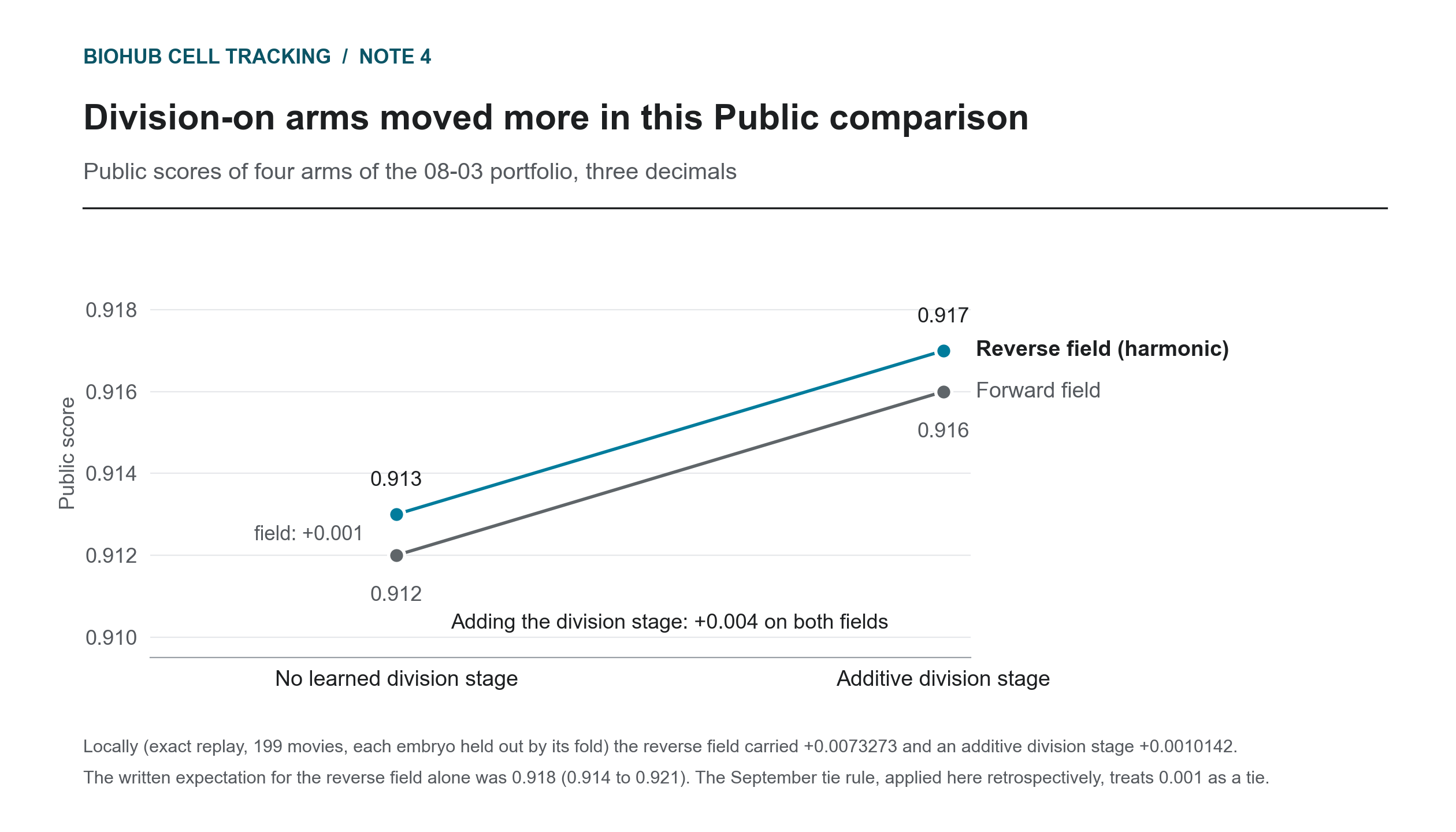 Figure 1. Public scores of four arms of the 08-03 portfolio. Adding the division stage moved both fields by \(0.004\); switching to the reverse field moved either pipeline by \(0.001\), a tie under the September reading rule applied here retrospectively. Locally the field had carried most of the gain.
2.3 What the check settled
These matched readings supported a larger package effect from adding the division stage than from reversing association. The Public score combined edge and division terms, so it did not identify which term accounted for that difference.
The local association gain may have depended on the weaker fold-model graphs, whose node recall was near \(0.90\). The deployed models had trained on both embryos and could have offered fewer of the same errors to repair. This remained a hypothesis; the mixed-fold result examined next came from a different composition.
2.4 A retention gate that measured a component
On 08-04 a sibling composition, the joint association model with the exclusive division stage on top, reached \(+0.010205\) over 199 movies. A gate written before the run rejected it: the composed graph had to keep \(95\%\) of the association stage’s adjusted-edge gain, since collapsing forks deletes edges, and it kept \(91.82\%\). The gate guarded a share of one term, not the score, and so vetoed a positive total: C4, the Note 3 clause about components, applied to a gate of my own.
3. A Separate Composition Used Folds That Mixed Both Embryos
The fortnight’s largest local numbers came from a different replay and never reached the board; what they measured depends on which embryos each fold held.
3.1 A first warning, 08-05
In the 08-05 error anatomy (section 4.1), a label-free node-count regressor with \(R^2 = 0.471\) under random five-fold cross-validation over movies reached \(R^2\) of \(0.125\) and \(-0.269\) with a whole embryo held out. The audit named the gap within-embryo leakage and concluded:
1
Random folds over movies are not a valid protocol in this competition.
3.2 The largest local numbers of the fortnight
On 08-06 a multi-family composition completed a 199-movie exact replay, mixing a joint lineage-action model, the auxiliary center detector and appearance features into the two-seed association anchor under one authority weight \(a\), which sets how much say the auxiliary models get. At \(a = 0.20\) the association stage returned \(+0.014446\) over a baseline of \(0.7405959\); with the exclusive division stage on top, the sweep reached \(+0.031335\) at \(a = 0.50\), the upper bound enforced in code, and \(+0.034692\) at \(a = 1.00\) under an opt-in flag. Every composition passed every gate, all four outer folds and both embryos positive: at \(a = 0.20\) the 71-movie embryo gained \(+0.018084\) and the 128-movie embryo \(+0.013709\).
The 71-movie embryo, the weaker one in earlier families, was now the stronger, and on 08-06 I wrote that down as a reason for confidence: “Since train and test are embryo-disjoint, a family that stops depending on one embryo is better generalisation evidence, not worse.” Four days later my plan cited the composition as a measured gain and set an association target of that size.
3.3 What the Folds Were
Let \(D_A\) and \(D_B\) be all movies from the two embryos. A two-fold embryo-out evaluation trains on \(D_A\) and evaluates on \(D_B\), then swaps them. More generally, the embryo sets of training and evaluation must be disjoint:
\[\operatorname{embryos}(D_{\mathrm{train},k}) \cap \operatorname{embryos}(D_{\mathrm{eval},k})=\varnothing.\]Merely making each evaluation fold a subset of one embryo is insufficient if other movies from that embryo remain in training. In the next expression, \(D^{(p)}\) denotes all movies from embryo \(p\).
The \(+0.0144\) and \(+0.0313\) results used prefix-balanced policy folds, constructed as follows:
\[D=\bigsqcup_k D_k, \qquad \forall k,\,p:\quad \left|D_k\cap D^{(p)}\right|\approx\frac{\left|D^{(p)}\right|}{4}.\]Every fold held movies from both embryos: movie-out, which cannot estimate performance on an unseen embryo.
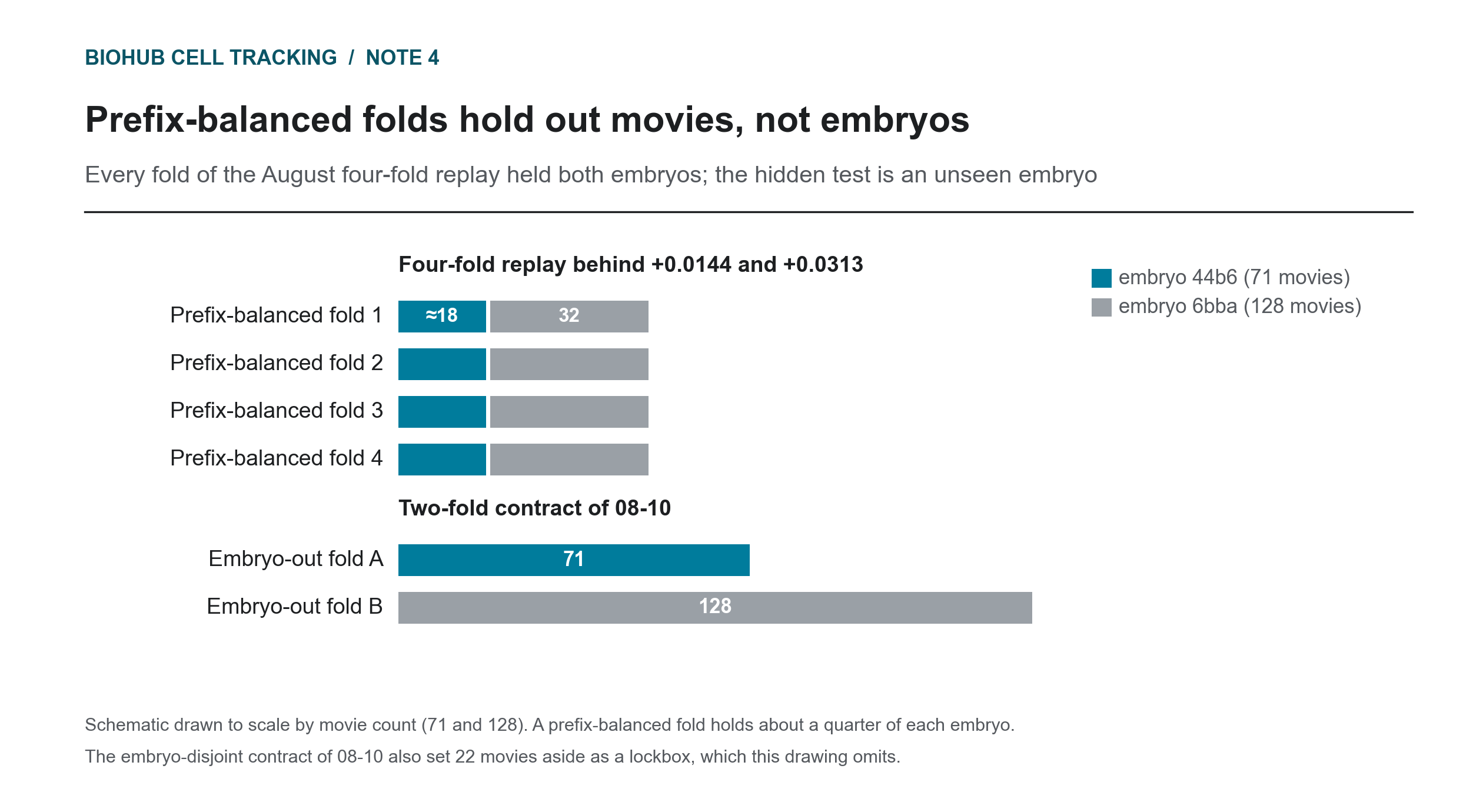 Figure 2. The four-fold replay behind the fortnight’s largest numbers balanced every fold across both embryos. The contract frozen on 08-10 holds out one whole embryo per fold.
Each policy fold trained on other movies from the embryo it evaluated. Balancing the two prefixes did not provide an unseen-embryo test. The August 6 explanation had extended the backbone’s embryo-out status to the whole composition without checking the policy splits.
3.4 The audit of 08-10, and the leak it found
On 08-10 I audited the evaluation protocol on the principle that out-of-fold status belongs to the whole composition, every threshold, gate and operating point included. It found leaks: a deployed gating model had re-split the 199 movies into five movie-level folds, training on other movies of the evaluation embryo; an operating point for pre-solver activation had been chosen while seeing both embryos’ labels; and a lockbox existed only on paper. The audit froze a two-fold embryo-disjoint contract: 177 development movies, and 22 in a lockbox opened once.
The four-fold results were demoted under the new contract: they “remain valid records of those experiments, but they are not evidence under this contract.” On 08-12 I recorded that the historical four-fold checkpoints mixed embryo prefixes.
3.5 A rerun under the embryo-disjoint contract
On 08-12 the multi-frame parent-or-null family, which picks each cell’s parent, or none, from five frames, was retrained and replayed under the new contract against a 177-movie anchor of \(0.7428367161\); on the four prefix-balanced folds it had returned \(+0.0133995\), positive in every fold and both embryos. Parent top-1 is the share of cells given the correct parent.
| arm, embryo-disjoint contract | adjusted-edge delta | component metric |
|---|---|---|
| multi-frame parent-or-null | +0.0001347503 | parent top-1 +0.0101 |
| two steps: parent-or-null first, then which parent | +0.0004766233 | parent top-1 -0.156 |
The number fell to about a hundredth, but the rerun changed more than the folds: it ran with a division guard, so its division delta is exactly zero, while the \(+0.0133995\) was unguarded and paid for its edges with a division loss of \(-0.0046489\). On the old folds an exact topology guard had already turned an unguarded \(+0.0163060\) on eleven movies into \(-0.0004684\), in a partial run stopped for futility. With 177 movies instead of 199, a new seed and a different anchor as well, this pair cannot size the fold inflation; the case against the folds rests on their construction. Both arms failed their gates, and I stopped this configured line of work.
The \(+0.0144\) and \(+0.0313\) compositions were not rerun under the new protocol. They remained historical mixed-fold measurements; their embryo-disjoint effects were unknown.
3.6 What a number from leaky folds does
The problem was not merely an inflated number. Calling the gain “measured” and using it as the next target allowed an unresolved validation claim to direct the search. C7 made the missing check explicit: every learned stage must exclude the embryo used to evaluate it.
4. A Detection Diagnostic Was Measured on Training Examples
What to test next depends on where the score is locked: in cells the detector never finds, or in links between those it does. Two measurements in one week, on different movies, pointed opposite ways.
4.1 Where the missed cells are, out of embryo
On the 199-movie replay baseline, an error anatomy of 08-05 found node recall \(0.8983\): \(119{,}759\) of \(133{,}318\) annotated cells matched a predicted node inside the \(7\,\mu\mathrm{m}\) gate, the radius within which the scorer pairs a prediction with an annotation. Of the \(13{,}559\) misses:
| class | count | share |
|---|---|---|
| no predicted node anywhere inside the gate | 13,457 | 99.25% |
| a node inside the gate, lost to assignment competition | 102 | 0.75% |
The distance analysis weakened a simple matching explanation. A found cell lands at a median of \(2.24\,\mu\mathrm{m}\) from its node, but a missed cell’s nearest predicted node sits at a median of \(9.60\,\mu\mathrm{m}\), against a median cell spacing of \(24.99\,\mu\mathrm{m}\). Those medians do not identify whether the nearest node is a displaced detection of the missed cell or a different cell; that would require examining the individual matches.
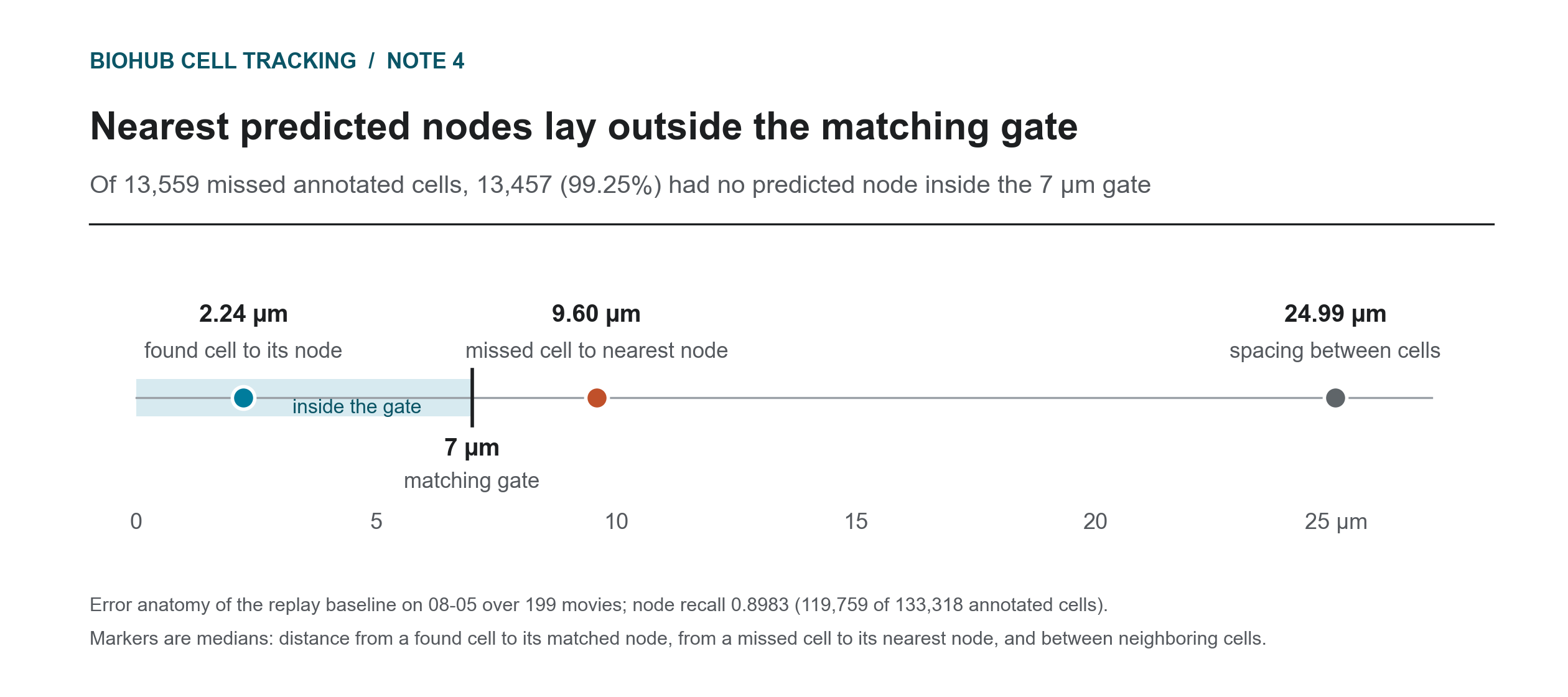 Figure 3. Medians from the 08-05 error anatomy of the replay baseline. A missed cell’s nearest predicted node sits beyond the \(7\,\mu\mathrm{m}\) gate, at a median of \(9.60\,\mu\mathrm{m}\). Distance alone does not establish its identity.
Crowding: the densest spacing bin has a miss rate of \(23.0\%\) but holds only \(339\) misses, \(2.5\%\) of the total. Most missed cells have no predicted point inside the matching gate. Reassigning edges alone cannot supply a missing matched endpoint: Note 3’s question of which points exist, now with a number.
4.2 “Detection is not the bottleneck”, and its retraction
On 08-07 an association oracle measured how much of the shipped pipeline’s score is locked behind detection: it keeps the predicted nodes, replaces the edges with ground-truth topology projected through the official matcher, and rescores, so an edge it still cannot place has an undetected endpoint. On the four labeled example movies distributed with the competition, the deployed graph had node recall \(0.983\) and only \(0.89\%\) of ground-truth edges unreachable, so detection looked non-binding, a detector retrain not worth its compute, and the schedule was changed.
On 08-08 I checked those movies: they are copies of training movies the deployed models were trained on, so the \(0.89\%\) is a hold-in number, measured on data the model has fit. The diagnostic was then run on research replays from the same detection family with embryo-out weights:
| regime | movies | GT edges unreachable |
|---|---|---|
| deployed graph, hold-in | 4 | 0.89% |
| research replay, embryo-out | the same 4 | 8.79% |
| research replay, embryo-out | 199 | 12.10% |
Over 199 movies out of embryo, perfect association lifts the replay’s \(0.7346\) to \(0.9380\): the label-assisted replacement gained about \(+0.20\) on this fixed node set, while about one ground-truth edge in eight lacked a matched endpoint. This is potential within that diagnostic, not a gain a trainable association model was shown to attain. The claim was retracted and the schedule decision reversed; the corrected reading is that “association is the largest lever, and detection is probably binding near the top of the board”, so part of what the board scores is set by points no association gain can add, an inference like that of section 2.3.
Even the two rows on the same four movies differ on two axes: hold-in versus embryo-out weights, and the deployed pipeline versus the research replay. No comparison in this window separated those effects. The deployed notebook was the right object and the example movies the wrong sample: a number from movies the model trained on measures fit, not generalization (C8).
4.3 The ablation headlines
The same 08-08 review retracted two headlines from a feature-family ablation on 34 movies of the section 3 composition: removing the temporal family “keeps \(1.2\%\) of the gain”, and the auxiliary center detector alone is “worse than nothing, at \(-17.2\%\)”. Both were division artifacts: with \(TP = 2\) against 89 false positives in the control, one event moved the pooled division Jaccard, \(TP/(TP+FP+FN)\) at weight \(0.1\), by half its value and swamped the edge differences. On edges alone the figures are \(13.0\%\) and \(-4.6\%\); the ranking survived.
5. Scoring the Graph, Not the Component
A released, pretrained cell-tracking representation was adapted into a parent ranker and measured embryo-out: a routing policy, fitted on one embryo and evaluated on the other, decided cell by cell whether to trust the new ranker or the existing consensus. Parent top-1 rose by \(+0.008366\) (\(0.874241 \to 0.882607\)), positive in both held-out embryos; the exact graph replay over 177 movies returned \(-0.002687\), \(69\) movies better and \(107\) worse.
The finished graph is not the parent decision but \(\hat G = R_{\mathrm{gap}} \circ R_{\mathrm{prune}} \circ \Pi_{\mathrm{parent}}\), and the short-component filter \(R_{\mathrm{prune}}\) acts on the connectivity that \(\Pi_{\mathrm{parent}}\) produces. Switching parents let components short enough to prune survive, and gap recovery extended them: the graph gained \(9{,}357\) predicted nodes, of which \(184\) matched a ground-truth cell. On switched rows that overlap a sparse parent label, the new model was \(899\) decisions more accurate than the consensus it replaced: better at its own task, worse for the graph.
I stopped work on this adaptation on 08-10, based on the graph replay. The result traced a concrete interaction with pruning and recovery; it did not rule out every use of the pretrained representation. C4 was reconfirmed with the path traced: component accuracy can improve while graph score falls when downstream stages react to changed connectivity.
6. Getting Candidates to Run, and Keeping Checks Proportionate
6.1 A candidate has to finish
Note 3 ended with seven blank pre-solver submissions, with runtime as the remaining hypothesis, and a plan to cut proposal inference to one model per movie. On 08-01 three candidates tested that plan at three activation budgets; all ran cleanly on the four example movies, exceeded the hidden runtime limit and returned no score: inserting proposed points forced a second full pass of the association model over every movie.
On 08-06 the limit got the model Note 3 had asked for: a deployment must satisfy \(F + m\,k \le 43{,}200\) s, with fixed setup \(F\), work \(m\) on the four example movies, and a factor \(k\) that scales them to the hidden set. The example movies hold \(42\%\) more cells than the average training movie, so \(k\) is only a bracket, and the deployed pipeline had between \(0\%\) and \(+17.6\%\) of spare capacity. A candidate would spend a slot only if it fit at the pessimistic end; on 08-08 the pre-solver family left the deployment plan on that record, its local signal still positive (C6).
6.2 Four notebook runs, four environments
On 08-07 and 08-08 four consecutive Kaggle notebook runs of the runtime probe produced no measurement, each for a reason diagnosable from local artifacts: a package resolved from the wrong attached dataset, a mount path missing from the deployment image, a wrong state-dict key, a construct that Python 3.12 rejects and local 3.11 accepts; each time the local check was the easier environment, so it passed. The first run wrote every required output and recorded its failure in a field nothing downstream read. A completed process is not a measurement.
6.3 When a check costs more than the question
On 08-10 and 08-11 I wrote a program for the remaining weeks with a Public score of \(0.970\) as its outcome target (\(0.921\) on the day) and a \(480\)-hour GPU ladder. A target in board units turns every board reading into a progress report, in tension with C9 in the same plan. The program also brought an admission system founded on section 6.2’s finding that an exit code is not a scientific decision: eight declarations before every launch, four independent evidence checks, hashed launch receipts.
| date | what followed |
|---|---|
| 08-13 | a measurement run finished all 204 planned passes and was filed as a runtime failure for exceeding a frozen 3.5-hour cap by 0.6166 s |
| 08-15 | a capture chain failed five times in a row, the last because a generic all-finite validator rejected a NaN that the producer defines as “no match” (1,379.575 s billed) |
| 08-16 | one commit added 1,193 files and 646,428 lines of experiment governance |
These incidents documented avoidable delay and rework. They motivated simpler checks, though the record does not quantify the total cost against the errors those checks prevented.
Closing
The reverse-only package missed its written expectation (\(0.913\) against \(0.918\)). On August 8, the hold-in diagnostic used to set the research schedule was withdrawn. The August 10 audit then replaced movie-level policy folds with an embryo-disjoint contract, under which the \(+0.0144\) and \(+0.0313\) compositions remained untested.
The revised protocol defined a better comparison, but only two embryo domains were available. The next note follows the decision to freeze a local comparator and examines what that fixed graph could, and could not, test.
Decision record, evolving criteria and remaining questions
The tables below retain the period’s decisions. The clauses summarize the scope of the evidence; their presence does not certify that every earlier experiment satisfied them.
7. Decision Log
For five days the board was used heavily on the division stage, whose operating points the replay had not adequately evaluated, and the 08-03 portfolio was a designed sanity check of the largest local association gain. On 08-10 the protocol restricted Public to matched sanity checks with written expectations, treating it as target-domain feedback rather than an optimizer for adjacent settings (C9).
| decision | reason at the time | what came back | what it changed |
|---|---|---|---|
| 08-01: three pre-solver runs, one proposal model per movie | test July’s runtime hypothesis | no score at any budget | runtime model; family out of deployment (C6) |
| 08-01 to 08-05: portfolios on the division stage | the earlier division package had a larger Public delta than its local delta | adjacent settings tied; one collapse | board limited to matched checks (C9) |
| 08-03: field against division stage, written expectations | separate what transfers | field tied its control; division stage +0.004 | the tested division package gained on Public |
| 08-04: 95% edge-retention gate | protect the association gain | +0.010205 rejected at 91.82% | C4 applies to gates too |
| 08-06: authority sweep on four prefix-balanced folds | stratified; every fold and both embryos positive | movie-out folds; a guarded embryo-out rerun of one family kept about a hundredth | C7; four-fold numbers demoted |
| 08-07: detection ceiling on the deployed graph | measure the pipeline that ships | 0.89% hold-in; 8.79% embryo-out | retracted 08-08; C8 |
| pretrained parent ranker, judged on the graph | parent top-1 +0.008366 embryo-out | graph -0.002687 | closed 08-10; C4 with a mechanism |
| 08-11: admission system | an exit code is not a scientific decision | a complete run filed as failed over 0.6166 s | checks must fit the question (open) |
The criterion at the end of this period
| clause | wording | since |
|---|---|---|
| C1 | Separate fitting, calibration and evaluation dependencies, and score the whole graph; movie separation alone does not ensure domain independence | Note 2 |
| C2 | Write each gate down before the result exists | Note 3 (07-15) |
| C3 | Calibrate a rule on the population it will act on | Note 3 |
| C4 | Judge a component by the graph it produces, in an exact replay, not by its own accuracy | Note 3 |
| C5 | Bind every level and delta to its comparator; do not rank deltas from different replays | Note 3 |
| C6 | A candidate must finish on the hidden set within the time limit | Note 3 |
| C7 (new) | Folds hold out a whole embryo (embryo-out) | Note 4 |
| C8 (new) | Numbers from movies the deployed model trained on (hold-in) are not evidence of generalization | Note 4 |
| C9 (new) | Use the board for matched sanity checks with a written expectation, not to choose adjacent settings | Note 4 (08-10) |
8. What the Period Established
Established
- Harmonic reverse-time association improved the replay by \(+0.0073273\) over 199 embryo-out movies, both embryos positive; best of four predeclared candidates, all positive.
- On the board the field alone read \(0.913\) against a written expectation of \(0.918\), a tie with its forward control (\(0.912\)); with a division stage, also a tie (\(0.916 \to 0.917\)).
- Collapsing every fork under an exclusive division stage cut division false positives from \(587\) to \(67\), retained \(99.30\%\) of the edge gain and reached \(+0.0106431\) (board: \(0.920\) against \(0.917\) at the same \(0.012\) budget, at the later rule’s investigation boundary; \(0.919\) at twice the budget, a tie).
- The division stage moved the board by four thousandths with either field, where the replay credited it with \(+0.0010142\): a direction on two rounded pairs, not a rate.
- Adjacent operating points of the division stage are indistinguishable on the board: four ties and one collapse on 08-04, five ties on 08-05.
- On the replay baseline, \(99.25\%\) of the \(13{,}559\) missed annotated cells had no predicted node inside the \(7\,\mu\mathrm{m}\) gate.
- The deployed hold-in graph left \(0.89\%\) of GT edges unreachable; the embryo-out research replay left \(8.79\%\) on the same four movies and \(12.10\%\) over 199. Both the training regime and pipeline changed, and the original claim was retracted.
- The ablation headlines were artifacts of a division term with \(2\) true positives; on edges the ranking survived.
- The four outer folds behind \(+0.014446\) and \(+0.031335\) were balanced within each embryo prefix: movie-out, not embryo-out.
- The multi-frame family returned \(+0.0133995\) unguarded on those folds and \(+0.0001347503\) embryo-out with a division guard.
- A parent ranker \(+0.008366\) better on held-out parent top-1 made the 177-movie graph worse by \(-0.002687\) (\(9{,}357\) nodes added, \(184\) matched).
Supported but Unconfirmed
- The \(+0.0144\) and \(+0.0313\) compositions might shrink under embryo-disjoint evaluation; the mixed folds prevent a generalization claim, but do not measure the size or even the direction of that change.
- Different error populations in the research and deployed graphs could explain the reverse field’s smaller Public effect.
- The hold-in \(0.89\%\) cannot be assumed on hidden embryos; the available comparisons do not locate their detection-locked fraction between the observed values.
Open Questions
- What is the detection ceiling of the deployed pipeline, measured out of embryo?
- Do the \(+0.0144\) and \(+0.0313\) compositions survive the embryo-disjoint contract, and at what size?
- Does any association gain survive that contract at a size the board can display? Every association candidate measured under it in this window came in below \(+0.0005\).
- Is there any stable ratio from local gains to the board? My plan for the remaining weeks quotes \(0.14\times\) to \(0.9\times\); this note’s portfolio fits no single band.
- Where else in the pipeline is a learned stage still fitted across the embryo boundary?
Series: